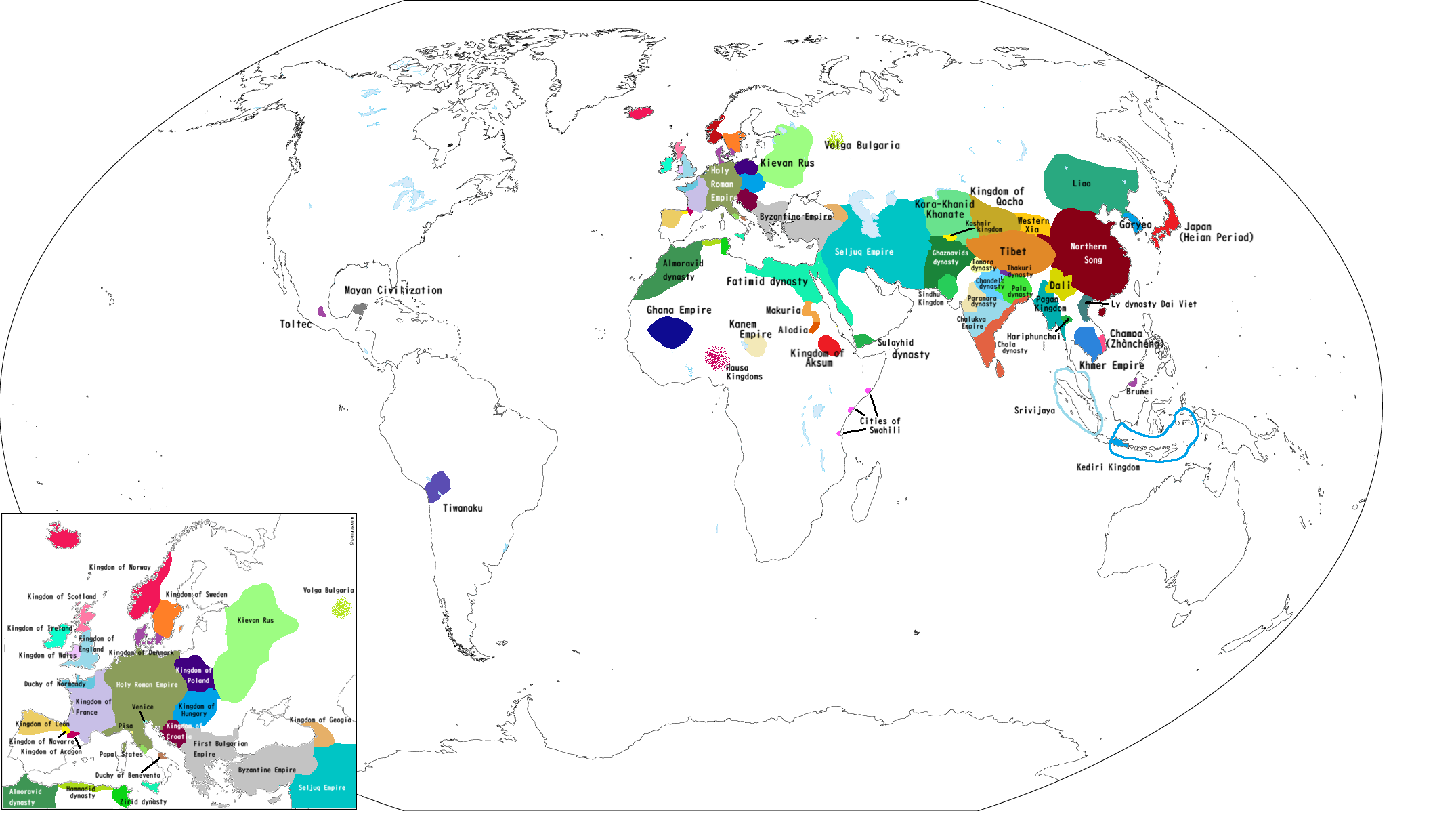
11th century The Power of the Pope and Retired Emperor



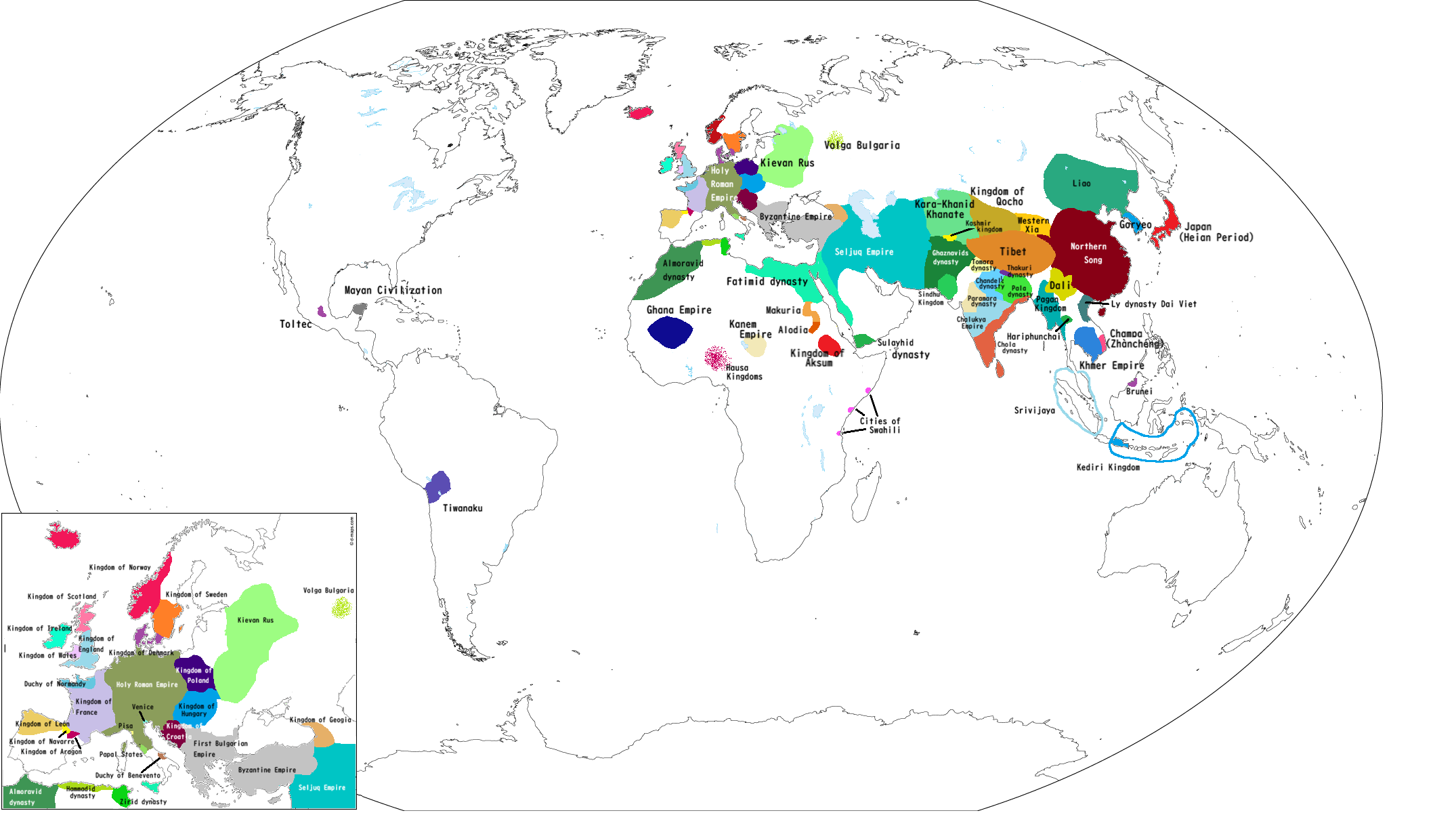
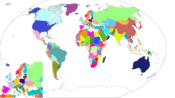
As for the major developments of the 11th century, Viking activity in Northern Europe was having its last great flourish, while in Western Europe the struggle for power between the Pope and the Holy Roman Emperor intensified. In the midst of this, the Crusades also began.
In the Middle East, Turkic peoples from Central Asia established great dynasties, Islamic forces advanced into India, and China under the Song produced remarkable culture while facing pressure from surrounding regions.
Japan
Fujiwara regency politics reached its peak in the 11th century. Fujiwara no Michinaga(藤原道長)’s famous line, “この世をば我が世とぞ思ふ望月の欠けたることも無しと思へば (This world is truly my world; I think even the full moon has no lack)”
shows just how arrogant he was.
There were also many outstanding women serving at court at this time. Murasaki Shikibu(紫式部), who wrote The Tale of Genji(源氏物語), was one of them, and she also kept a diary separately, which has become a valuable source for understanding court life in that era.

Meanwhile, in the provinces, samurais were becoming increasingly prominent. In particular, the Minamoto(源) clan, which suppressed the northeastern rebellions (the Zenkunen War(前九年合戦) in 1051 and the Gosannen War(後三年合戦) in 1083), and the Taira(平) clan, which rose in western Japan, became the two major powers.
Among the common people, the idea of the “Age of Mappo(末法の世)” spread widely. This was the belief that a certain amount of time had passed since the Buddha’s death, after which people could no longer receive his compassion. In reality, since famine and rebellions and other forms of social disorder did not subside, people came to hope that at least in the afterlife they could live peacefully. This was the rise of Pure Land belief(浄土信仰).
Under these circumstances, the Fujiwara family after Michinaga could no longer maintain regency politics, and it was replaced by rule by retired emperors, known as “insei”(院政). The “full moon” in Michinaga’s poem was, in a sense, destined to wane after its peak.
China and East Asia
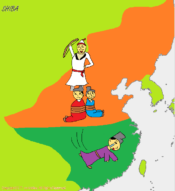
China had been reunified under the Song(宋), but the Liao(遼) dynasty founded by the Khitan(契丹) nomads in the north continued to dispute the border with the Song. In 1004, the Treaty of Shanyuan(澶渊之盟) was concluded between the Song and the Liao. By giving the Khitan annual payments of silver and silk, the Song maintained peace for more than 100 years afterward.
Similarly, in 1038, a people called the Tangut established another dynasty in inland China. This was the Western Xia(西夏). In 1044, the Song also made peace with Western Xia’s first emperor Li Yuanhao(李元昊) in the Qingli Treaty(慶曆和议) and paid silver and silk.
Although politically disadvantaged, the Song experienced population growth thanks to the development of new farmland in southern China. Commerce also flourished, and Jingdezhen(景德镇) ceramics in particular became popular across the world.
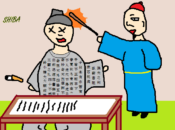
With the spread of the civil service examinations, the old hereditary aristocracy disappeared, and the elite known as the “shi da fu(士大夫)”, meaning examination passers, came to lead Song society.
Song culture was also led by the shi da fu. Notable cultural figures of the 11th century included Ouyang Xiu(歐陽脩) and Su Shi(苏轼), who worked to revive the ancient prose style of earlier times, free from rigid formalism; the historian and statesman Sima Guang(司馬光), who wrote the historical work ”Zizhi Tongjian(資治通鑑)”; and the Confucian scholar Zhou Dunyi(周敦頤).
Even though peace was maintained, the Song could not afford to relax its vigilance toward either neighboring state. In addition to the annual silver and silk payments, the cost of guarding the borders worsened the Song’s finances, which were already strained by the large number of civil service officials and the salaries they required. It was in this context, during the reign of Emperor Shenzong(神宗) in the mid-11th century, that Wang Anshi(王安石) emerged and carried out bold reforms as chief minister.
The main laws enacted by Wang Anshi included the “Green Sprout Law(青苗法)”, which provided low-interest loans to struggling farmers to protect them from moneylenders; the “Equal Transport Law(均輸法)”, under which the government bought local specialties and resold them in areas of shortage to support state finances; and the Baojia system(保甲法), which reduced military expenses by having farmers in off-seasons serve as soldiers instead of hiring mercenaries.
These reforms were strongly aimed at rescuing vulnerable farmers and merchants while restraining the power of landlords and wealthy traders. For that reason, landlords who suffered losses, as well as conservatives such as Sima Guang, strongly opposed them, and after Shenzong’s death, Wang Anshi was driven from power.
The Khitan also invaded Goryeo(高麗/고려) to the east, and in 1010 even attacked its capital, Gaegyeong(開京/개경) (present-day Kaesong in North Korea). Although Goryeo found itself in a critical situation, it reorganized its forces under the military leader Gang Gam-chan(姜邯贊/강감찬) and achieved victory over the Khitan in 1019. Afterward, peace was concluded between the two states.
With the conflict against the Khitan settled, economic activity became more active from the mid-11th century onward. Local specialties such as ginseng and Goryeo celadon (ceramics) came to be widely traded. Exchanges with Japan and the Song dynasty were also carried out through Buddhism. At the same time, Confucianism spread in Goryeo, and because it was used in the civil service examinations, schools were established to teach it.
Southeast Asia
In Vietnam, the struggles that followed independence from China finally subsided, and in 1009 the Lý dynasty was founded with the accession of Lý Công Uẩn. In 1054, the country was renamed Đại Việt(大越). As the name shows, Vietnam at the time was part of the Sino-cultural sphere. Thereafter, Đại Việt maintained tributary relations with the Song while accepting its system, yet remaining alert to avoid falling under Song rule.
In the basin of the Ayeyarwady River in western Indochina (present-day Myanmar), the Burman people gradually unified, and a dynasty centered on Pagan was established. The first king, Anawrahta, did not pursue discriminatory policies toward other peoples such as the Mon; instead, he incorporated the Buddhism they revered and sought to stabilize society.
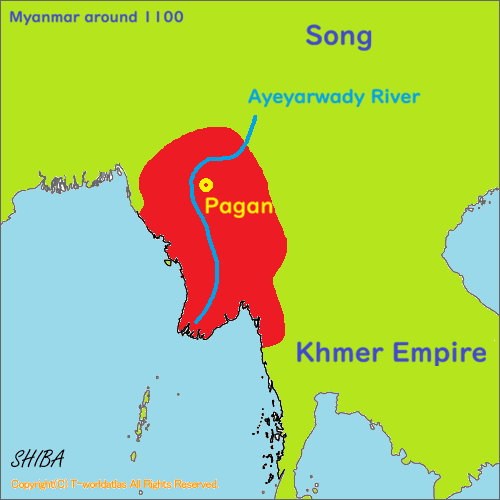
However, the most powerful state in Indochina was Cambodia under the Khmer Empire. As southern China developed, trade with Southeast Asia became even more active, and the Khmer Empire, which controlled the great rivers such as the Mekong and the Chao Phraya, especially benefited from this. Even so, there was also the rival kingdom of Champa to the east, and the two sides continued to compete fiercely.
In the Strait of Malacca, Srivijaya continued to flourish as a center of trade. However, around 1025 it was invaded by the powerful Chola dynasty of South India and came under its strong influence. This influence did not disappear until the 12th century.
South Asia
As noted above, in southern India during the 11th century, the Chola dynasty united the surrounding regions through Hinduism and became increasingly powerful. This dynasty, projecting across the Indian Ocean, also conquered Sri Lanka and the Maldives in the reign of Rajendra I in the mid-11th century. Its attack on Srivijaya was an extension of this expansion.
Naturally, trade across the Indian Ocean also flourished. One theory holds that horses brought from the Middle East also began to be widely raised in southern India in the 11th century.
Meanwhile, in northern India, the Islamic Ghaznavid dynasty, based in Afghanistan, invaded. This invasion led to the decline and eventual collapse of the Hindu Pratihara dynasty. After this, Islamic powers began to penetrate India as well, making the religious structure of the region even more complex.
West Asia
At the beginning of the 11th century, Baghdad, the center of the Islamic world, was controlled by the Persian Buyid dynasty. Into this situation came the Turkic Seljuks from Central Asia. Turkic peoples, long respected as military men who used horses, turned that power into a literal “weapon” and invaded Baghdad. They expelled the Buyids and became the new rulers of Baghdad. Their leader, Tughril Beg, received the title of “sultan” from the caliph in 1055.
In this way, the Seljuk dynasty became the hegemon of West Asia, and Turkic peoples migrated from Central Asia to the Middle East. In the Battle of Manzikert in 1071, they defeated the Byzantine Empire and seized Anatolia, which had been under Byzantine rule. The entry of Turks into what is now the Republic of Turkey dates, in fact, to this period.
Turks were not the only important figures in the Islamic world at this time. One of the most active statesmen of the late 11th century as vizier of the Seljuk dynasty was the Persian Nizam al-Mulk. He built madrasas, or centers of learning, in Baghdad and elsewhere. These institutions, known as the Nizamiya madrasas, played an important role in the development of Islamic culture, together with institutions such as the House of Wisdom from the Abbasid period.
In fact, the 11th century was also a time when many brilliant figures appeared who greatly advanced Islamic culture. Ibn Sina left behind significant achievements in the fields of medicine and philosophy in the early 11th century, while Omar Khayyam made major contributions to astronomy and literature in the late 11th century.
North Africa and the Iberian Peninsula
The Umayyad Caliphate of Córdoba, which had flourished in the Iberian Peninsula, fell into disorder due to internal power struggles in the 11th century and collapsed in 1031. The Christian kingdoms advancing the Reconquista saw this as a perfect opportunity and launched their campaigns, led by the Kingdoms of Castile and Aragon, which would later form the basis of Spain.
The Kingdom of Castile recaptured Toledo, a key city in the center of the peninsula, under Alfonso VI, and grew into the largest kingdom in Iberia. Meanwhile, the Muslim side sought assistance from North Africa across the strait (modern-day Morocco).
In the regions corresponding to present-day Morocco and Mauritania, many indigenous Berber people lived. Islam had taken root among them as well, and from among them emerged a group known as the Almoravids, who adhered to a strict form of Islam. This group founded the Almoravid dynasty in 1056, conquered much of Morocco, and established their capital at Marrakesh, which remains a popular tourist destination today.
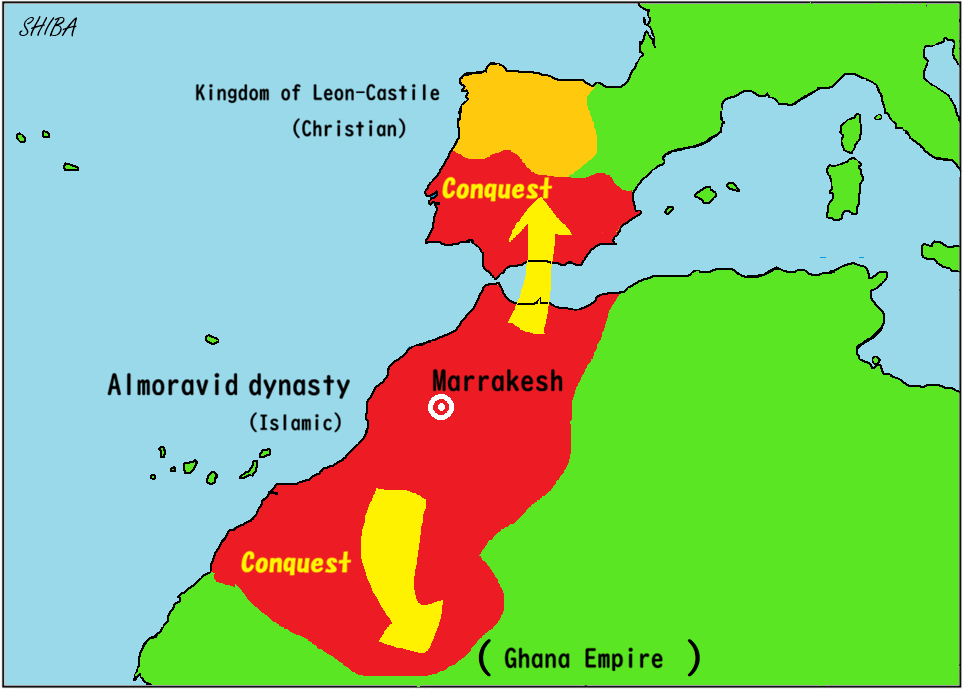
Yusuf ibn Tashfin, who came to power in 1061, checked the southward advance of Castile and conquered the southern Iberian Peninsula (the Andalusian region), securing extensive territories and sea routes across the Strait of Gibraltar. At the same time, the Almoravids also expanded southward into Africa, and in 1076 they invaded the Ghana Empire, which had prospered along the Niger River.
Eastern Europe and the Caucasus
Peoples such as the Slavs and Magyars, relatively “newcomers” to the European stage, became fully integrated into Europe in the 11th century, with Hungary and Poland consolidating as kingdoms.
In the Balkan Peninsula, the Byzantine Empire regained strength under Emperor Basil II and reconquered the Bulgarian Kingdom by around 1018. However, although it was a Christian state of the Eastern Orthodox tradition, it came into conflict with the Catholic world. In 1054, the Byzantine emperor, head of the Eastern Orthodox Church, and the Pope of Rome, head of the Catholic Church, excommunicated each other, making reconciliation between the two branches impossible.
In the Caucasus region, kingdoms such as Armenia, Iberia (unrelated to the Iberian Peninsula of Spain), Abkhazia, and Tao-Klarjeti repeatedly formed and dissolved alliances. Bagrat III, born to the king of Iberia and the queen of Abkhazia and later adopted by the king of Tao-Klarjeti, unified these realms in 1008, creating the Kingdom of Georgia. Meanwhile, the Armenian Kingdom declined due to internal strife and was annexed by Byzantium in 1045.
From the mid-11th century, the Seljuk Empire expanded into the Caucasus and Anatolia. As mentioned earlier, after the Battle of Manzikert in 1071, the Byzantine Empire began to lose control of Anatolia. Eventually, the Byzantine emperor would seek aid from the Pope. The Kingdom of Georgia also fell into a subordinate position to the Seljuks for a time from the mid to late 11th century.
Northern and Western Europ
The Danes, active in Viking expeditions, advanced into the British Isles in the early 11th century. Among them, King Cnut the Great ruled as king of Denmark, Norway, and England, forming what is known as the North Sea Empire. Although it lasted only for his lifetime until his death in 1035, it controlled the North Sea and its surrounding regions.
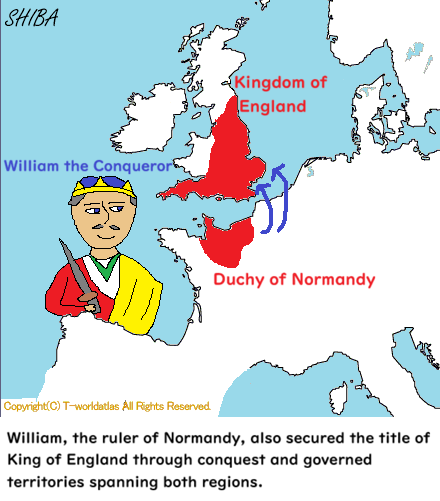
In the latter half of the 11th century, England faced another invasion—from the Duchy of Normandy, founded in northern France in the 10th century. Its ruler, William, entered London in 1066 and became King William I of England. As a result, the Norman dynasty ruled a realm spanning England and northern France, laying the groundwork for the Hundred Years’ War that would occur centuries later.
In the early 11th century, Germany (the Holy Roman Empire) grew powerful, incorporating regions such as the Kingdom of Bohemia (present-day Czech Republic). At first, the Pope continued to exist in a semi-protected position under the Holy Roman Empire.
However, Gregory VII, who assumed the papacy in the latter half of the 11th century, sought independence from the Empire as part of his efforts to reform the भ्रष्ट Catholic Church. This was opposed by Henry IV, the future Holy Roman Emperor, but he was excommunicated by Gregory. Faced with the loss of his followers’ trust, Henry traveled to Canossa, where the Pope was staying, and begged for forgiveness. This event is known as the “Humiliation of Canossa.”
During this period, monastic activity flourished across Europe, contributing to developments in learning and culture. The University of Bologna, often regarded as the oldest university in Europe, was established in Italy in the 11th century. There, various fields such as theology, medicine, mathematics, and logic were studied and taught. In art, the Romanesque style developed, characterized by semicircular arches placed atop columns; the Pisa Cathedral is a representative example (the Leaning Tower of Pisa belongs to a later period).
The Crusades
The authority of the Pope increased greatly, and he came to command even the kings of the Catholic world (i.e., Europe). In 1095, Pope Urban II called upon rulers across Europe at the Council of Clermont, marking the beginning of the First Crusade.
Their stated objective was to reclaim Jerusalem, the holy city occupied by Muslims, whom they regarded as infidels. However, it is also said that there was a more practical background: with Europe’s growing population, there was a pressing need for new lands.
In 1099, the Crusaders captured Jerusalem, and one of their leaders, Baldwin I, established the Christian Kingdom of Jerusalem. Meanwhile, many of the Muslims and Jews living in Jerusalem were killed.
For this reason, even today, some extremist groups in the Islamic world criticize actions such as attacks by the United States by referring to them as “modern Crusades.”
Events
1004 Treaty of Shanyuan: Peace concluded between the Liao and Northern Song (East Asia)
1008 Unification of the Kingdom of Georgia (Caucasus)
Early 11th century Murasaki Shikibu begins writing The Tale of Genji (Japan)
1009 Establishment of the Lý dynasty and Đại Việt in Vietnam (Vietnam)
1014 Brian Boru, King of Ireland, is killed in battle just before unifying the island (Ireland)
1016 King Cnut of Denmark becomes King of England (until 1035) (Northern Europe / Britain)
1017 The Chola dynasty of South India invades Sri Lanka (South Asia)
1018 Byzantine Emperor Basil II conquers the Bulgarian Empire
1019 The Islamic Ghaznavid dynasty destroys the Hindu Pratihara dynasty (India)
Around 1020 – Central Asian scholar Ibn Sina completes The Canon of Medicine
1031 Collapse of the Umayyad Caliphate of Córdoba (Iberian Peninsula)
1037 Establishment of the Kingdom of León-Castile (Iberian Peninsula)
1038 Establishment of the Seljuk Empire (Central Asia / West Asia)
1038 Li Yuanhao founds Western Xia (East Asia)
1044 Establishment of the Pagan dynasty by the Burmese (Myanmar)
1051 Zenkunen War begins (until 1062) (Japan)
1054 The Roman Catholic and Eastern Orthodox Churches mutually excommunicate each other, causing a schism (Europe)
1066 William, Duke of Normandy (William I), conquers England (Britain / France)
1069 Wang Anshi’s reforms begin (until 1076) (China)
1071 Battle of Manzikert: the Seljuks defeat the Byzantine Empire and advance into Anatolia (West Asia)
1076 The Almoravid dynasty of Morocco conquers the Ghana Empire (North Africa)
1077 The Humiliation of Canossa (Europe)
1083 Gosannen War begins (until 1087) (Japan)
1085 The Kingdom of León-Castile conquers Toledo in central Iberia (Iberian Peninsula)
1086 Retired Emperor Shirakawa begins cloistered rule (insei) (Japan)
1095 Council of Clermont; the First Crusade begins (Europe)
1099 Establishment of the Kingdom of Jerusalem by the Crusaders (West Asia)