12th century Military Regimes Rise


(11th century) ← → (13th century(Japanese))
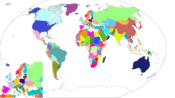
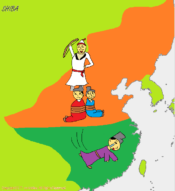
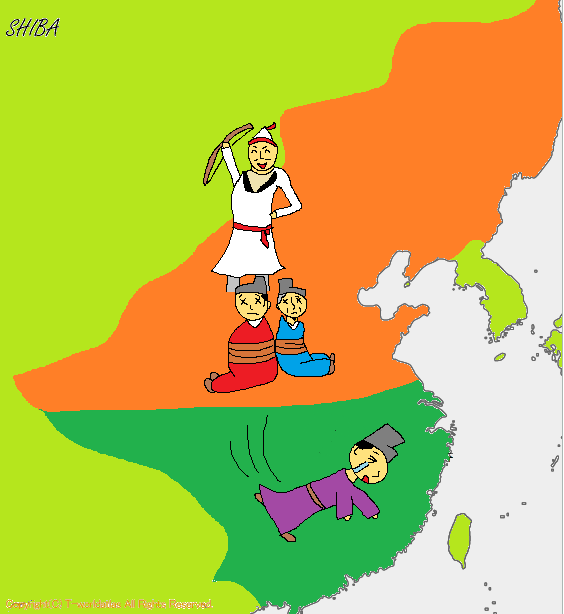
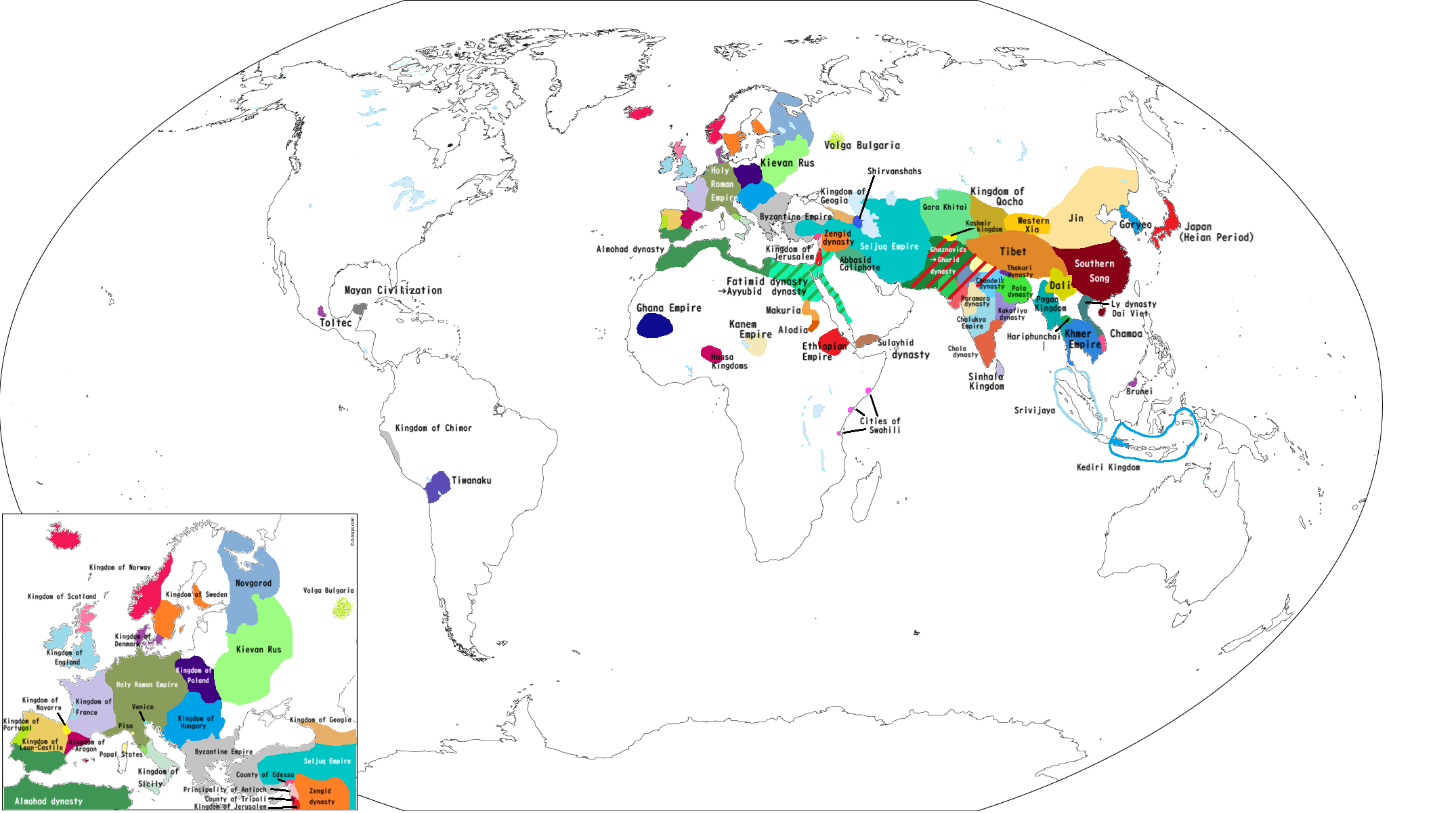
The Kingdom of Jerusalem, established by European Catholics, was, so to speak, a military state founded by knights. Curiously, the twelfth century was also a time when military men rose to prominence and began taking control of politics in both the East and the West. Examples include Egypt’s Ayyubid dynasty, the military regime in Goryeo, and Japan’s Kamakura shogunate. On the other hand, some countries, such as Song China, continued to follow a civil-oriented system of government.
West Asia and Egypt
Although the Muslim powers had lost the Holy Land, including Jerusalem, and the eastern coast of the Mediterranean to Christian forces, Baghdad, the center of the Islamic world, was far from Jerusalem. As a result, the Seljuk dynasty that ruled the region was unable to respond effectively. Instead, it was the Zengid dynasty of Syria, which bordered the Kingdom of Jerusalem, that launched a “jihad” against the Christian states.
Damascus and Aleppo, today the first- and second-largest cities in Syria, were also important cities in the region at that time. However, the two cities competed with each other for supremacy and sometimes even formed alliances with the Kingdom of Jerusalem. The Christian kingdoms and Muslim kingdoms were not “like oil and water” simply because they followed different religions.
When the Zengid dynasty was established in Aleppo in 1127, it began conquering the Crusader states—there were several Crusader-ruled states besides Jerusalem—in the name of “jihad.” Nur al-Din, the dynasty’s second ruler, conquered Damascus in 1154, unified the region of Syria, and built a powerful dynasty.
Meanwhile, Egypt, on the opposite side of Jerusalem, was ruled by the Shiite Fatimid dynasty. By this time, however, the dynasty had grown weak and was also under pressure from the Kingdom of Jerusalem. Seeing this situation, Nur al-Din sent an army to Cairo. Among the soldiers was a man named Saladin.
In 1169, Saladin abolished the Fatimid caliphate and established the Ayyubid dynasty. Nur al-Din was furious, believing that Egypt had been taken from him, but he died of illness shortly afterward. Having lost its capable ruler, the Zengid dynasty was eventually conquered by the Ayyubid dynasty. After gaining control of Egypt and Syria, Saladin invaded the Kingdom of Jerusalem, which lay between them, in 1187. He captured Guy of Lusignan, the king of Jerusalem, and returned the holy city to Muslim rule.
Saladin later released Guy of Lusignan unharmed and came to be praised as a great ruler even by Europeans.
The fall of Jerusalem to Muslim forces led to the decision to launch the Third Crusade. One of its leaders was Richard I, King of England. Although he defeated Saladin’s forces several times, he was unable to recapture Jerusalem. During the campaign, he took the island of Cyprus amid the confusion and installed the former king of Jerusalem, Guy of Lusignan, as its ruler before returning to Europe. Guy of Lusignan subsequently lived out the rest of his life as King of Cyprus.
The Seljuk dynasty, which had extended its rule across much of the Middle East, was unable to prevent regional separatism, just as the Abbasid dynasty had been before it. The dynasty broke apart in 1157. The regime that had been based in Iraq and Iran was later conquered in 1194 by the Khwarazmian Empire, which had grown powerful in Central Asia.
As the Seljuk dynasty disintegrated, the Kingdom of Georgia in the Caucasus escaped from Seljuk rule. It subsequently prospered through trade with the Republic of Venice and reached its peak under Queen Tamar at the end of the twelfth century.
Morocco and the Iberian Peninsula
The Iberian Peninsula had long been a region where Christian and Muslim powers struggled against each other, even before the Crusades. The Kingdom of Castile, which later became part of Spain, was encouraged by the Crusading movement and captured Zaragoza in northeastern Iberia in 1118, making it its capital. To Castile’s east, the Kingdom of Aragon united in 1137 with the region of Catalonia, including Barcelona, thereby gaining access to the Mediterranean.
On the Atlantic side, Afonso, the Count of Portugal and a vassal of Castile, became independent. He was recognized as king in 1143, marking the establishment of the Kingdom of Portugal. Thus, three Christian kingdoms came to stand side by side in northern Iberia. While continuing their struggle against the Muslim powers—the Reconquista—they also became rivals among themselves.
Southern Iberia was under the rule of the Almoravid dynasty, which was centered in what is now Morocco. However, the religious fervor of the Almoravids, the activists who had supported the dynasty, had largely cooled after more than half a century. In their place, a new religious movement emerged. The austere Almohad movement, founded by Ibn Tumart, spread among the people, and Ibn Tumart eventually proclaimed himself the Mahdi, or messianic leader. In 1147, Abd al-Mu’min, who succeeded him, overthrew the Almoravid dynasty and established the Almohad dynasty.
By the end of the twelfth century, the Almohads had expanded their rule across the western Maghreb, or North Africa. In Iberia, they demonstrated the strength of a rising power by defeating the Kingdom of Castile at the Battle of Alarcos in 1195.
However, one point should not be misunderstood: there were Christians within the Almohad realm, just as there were Muslims in Christian territories. Since control of the various regions changed hands so frequently, this was only natural.
Western, Northern, and Southern Europe
As mentioned above, the Muslim dynasties and the Crusader states were not simply “like oil and water.” Contact between the Crusaders and Muslims brought more than warfare. European merchants who followed the armies began trading with the Islamic world and made considerable profits.
The Crusades were launched repeatedly into the thirteenth century, but wars naturally cost money. While merchants provided financial support for the Crusades, they also took advantage of the expeditions to expand their businesses and increase their power. The Italian city-states of Genoa and Venice were particularly successful in maritime trade and would later become major powers in the European world.
Scientific and technological knowledge developed in the Islamic world, as well as Greek philosophy that had been lost in Europe during the turmoil of the Middle Ages, was also imported through trade. It influenced medicine, literature, art, and other fields. In the Iberian Peninsula, cultural activities flourished during the Reconquista, with Islamic books falling into Christian hands and being translated from Arabic into Latin.

The Crusades were also launched in regions outside West Asia. The Finns living in what is now Finland still followed their traditional religion at the time and became targets of a crusade. The campaign was led by Eric IX of Sweden, after which Finland—initially only its southern part—came under Swedish rule.
Southern Italy and Sicily had also long been ruled by Muslim dynasties, but by this period Christian powers had replaced them. The people who played the decisive role were, surprisingly, the Normans, a branch of the Vikings. By this time, they had expanded their sphere of activity from Scandinavia to the Mediterranean.
Beginning in the latter half of the eleventh century, the Normans fought Muslim forces for control of Sicily and captured their strongholds. In 1130, Roger II, the ruler of the time, was recognized as king, and the Kingdom of Sicily was established.
Apart from the Crusades, the power struggle between the Holy Roman Emperor and the pope—the Investiture Controversy—reached a temporary settlement with the Concordat of Worms in 1122. Nevertheless, their struggle for power continued afterward.
The cities of northern Italy, located between Germany and Rome, took advantage of this conflict. Cities such as Milan and Florence grew powerful through commerce while using their support for either the emperor or the pope as a diplomatic bargaining chip to gain greater autonomy.
In 1167, Milan and several other cities formed the Lombard League and obtained various rights from the Holy Roman Empire. As a result, northern Italy followed a unique historical path, with city-states emerging in various regions alongside Venice and other powers.
In England, Henry II ascended the throne in 1154. His father had ruled Anjou in France, so Henry II inherited that territory as well. He also acquired Ireland and Aquitaine in southern France, becoming the lord of an enormous domain. Because of the design on the coat of arms of the House of Anjou, his dynasty is also called the Plantagenet dynasty, a name meaning “broom plant.”
In the latter half of the twelfth century, Richard I became king of England. Known as Richard the Lionheart, he participated in the Third Crusade, as described earlier. Although he failed to reconquer Jerusalem, he seized the nearby island of Cyprus.
Around the same time, Philip II ascended the throne of France and devoted himself to recovering the territories that had been taken by the English royal family.
By this period, the three-field system had spread throughout France and other regions. Under this farming method, farmland was divided into three sections: one for crops such as barley grown from spring to summer, one for crops such as wheat grown from autumn to winter, and one left fallow. The sections were rotated. This system increased agricultural productivity, and, together with a warming climate, caused Europe’s population to grow rapidly during this period.
Eastern Europe
The appeal for a crusade had originally come from the Byzantine Empire, but Byzantium viewed the struggle against Muslims differently from Western Europe. More than four hundred years had passed since the birth of Islam. Although the Byzantine Empire had suffered from the Islamic powers, it had also established relations of coexistence with them. As a result, the Byzantines gradually grew distrustful of the Crusaders, who sometimes massacred Muslims.
Even so, during the eleventh and twelfth centuries, local aristocrats in the Byzantine Empire frequently rebelled and refused to obey the central government. Emperor Alexios I implemented reforms that reduced the privileges—such as official positions and pensions—held by old aristocratic families and granted landholding rights and tax-collecting rights to new nobles close to him. These reforms reduced the emperor’s burden and suppressed aristocratic revolts. At the same time, however, the political system changed from the traditional theme system to a feudal system known as the pronoia system, and imperial power gradually became less effective in the provinces.
After the death of Alexios I, the pronoia system developed further during the latter half of the twelfth century, and some states became independent of the Byzantine Empire.
In the Balkans, the Kingdom of Serbia and the Bulgarian Empire became independent. Serbia had already broken away from Byzantine rule in the eleventh century, but it had been unable to achieve domestic unity. This was accomplished by Stefan Nemanja, who founded the Nemanjić dynasty in 1171. He stabilized the country by bringing the economically important Adriatic coast under his control. In his later years, he became a cleric and worked to spread Christianity, specifically Eastern Orthodoxy. The Bulgarian Empire, which had been conquered by Byzantium once in the eleventh century, regained its independence in 1187. It is known as the Second Bulgarian Empire.
The Armenians, who were scattered across the Caucasus, Eastern Europe, and various parts of West Asia, established a new kingdom at the end of the twelfth century. Since it was located in Cilicia, in what is now southern Turkey, it was called the Armenian Kingdom of Cilicia. Although it was far from the Caucasus, the kingdom established friendly relations with the nearby Crusader states, which were also Christian.
Japan
In Kyoto(京都), cloistered rule—where a retired emperor governed in place of the reigning emperor—continued after being initiated by the retired Emperor Shirakawa(白河上皇). Successive retired emperors also promoted the warriors who were gaining power at the time. Two major warrior clans emerged: the Minamoto(源) and the Taira(平).
In 1156, the Hōgen Rebellion(保元の乱) broke out over the succession to the retired Emperor Toba(鳥羽上皇). In 1158, the Heiji Rebellion(平治の乱) followed, as the victors of the earlier conflict fought one another. Taira no Kiyomori(平清盛) emerged victorious from both wars.
Kiyomori governed together with the retired Emperor Go-Shirakawa(後白河上皇), who had initiated a new period of cloistered rule. Kiyomori began trade with the Southern Song(南宋) dynasty in China and improved the Seto Inland Sea(瀬戸内海), the main waterway used for that trade. This development also contributed to Itsukushima Shrine(厳島神社) taking on much of its present form. Eventually, however, a rift developed between the two men, and Go-Shirakawa began relying on Minamoto no Yoritomo(源頼朝), who had been exiled to Izu(伊豆).
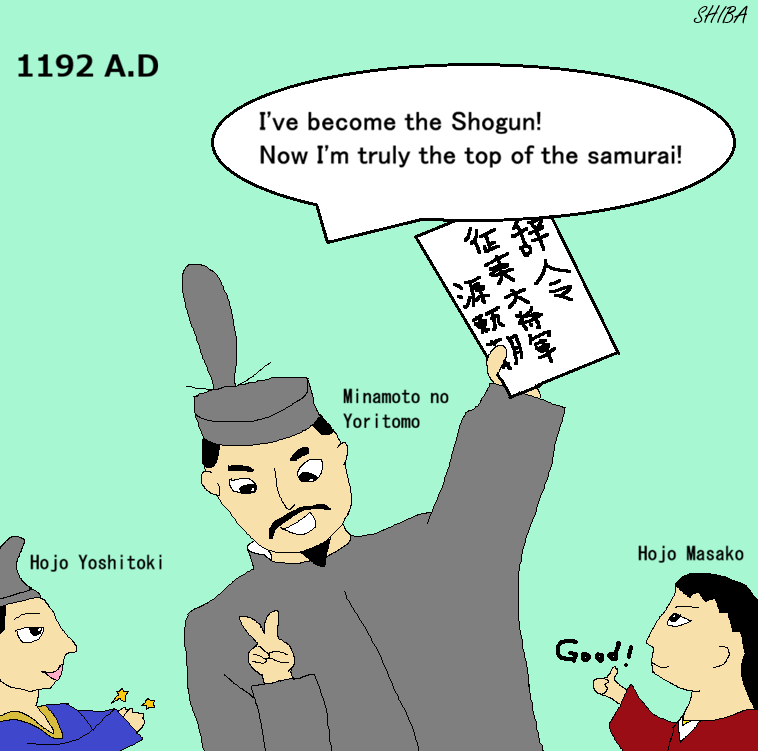
Yoritomo responded by rising in rebellion in 1180. Taira no Kiyomori died of illness the following year, and the Taira clan soon collapsed. Ironically, they were driven into defeat along the Seto Inland Sea, which they themselves had developed, and were destroyed at the Battle of Dan-no-ura(壇ノ浦の戦い) in 1185. During this period, Minamoto no Yoritomo established a political system run by warriors in Kamakura(鎌倉), far from Kyoto. He created the Kamakura bakufu/shogunate(鎌倉幕府), the first samurai government in Japanese history.
China and East Asia
In northern China, the Khitan(契丹) Liao(遼) dynasty had become a major power. In the twelfth century, however, a new power emerged from Manchuria(满洲), in northeastern China: the Jurchens(女真). Their leader, Wanyan Aguda(完顔阿骨打), founded the Jin(金) dynasty in 1115. The Liao dynasty was soon overthrown by the Jin and fled to Central Asia. The dynasty established there became known as the Western Liao(西遼), or Kara-Khitai.
The Jin also came into conflict with the Northern Song(北宋). In 1126, it captured Emperor Qinzong(钦宗) of the Northern Song and his predecessor, Emperor Huizong(徽宗). This incident is known as the Jingkang Incident(靖康之变). The Song imperial family was forced to move its base farther south. This new regime became the Southern Song(南宋).
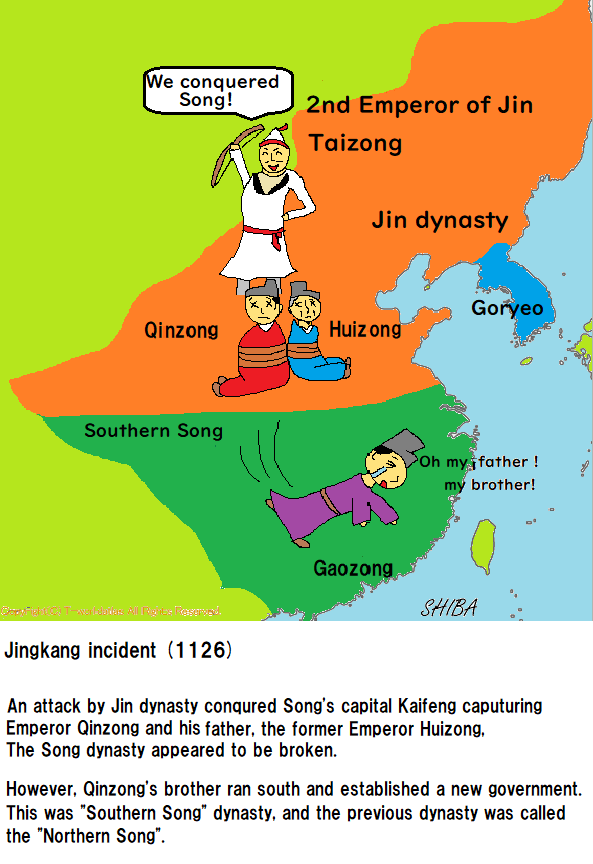
Thereafter, throughout the twelfth century, China was divided between the Jin in the north and the Song in the south. Fortunately, southern China was—and remains—a major rice-producing region, so Southern Song society remained stable. The Southern Song was also the country with which Taira no Kiyomori began trade.
The Korean Peninsula
In Goryeo(高麗/고려), which ruled the Korean Peninsula at the time, government officials were called yangban(兩班/ 양반). They were further divided into civil officials, known as munban(文班/문반), and military officials, known as muban(武班/무반). The military officials who commanded the army were regarded as inferior to the civil officials who controlled politics.
However, the Jin(金) dynasty mentioned above also threatened Goryeo, causing social unrest. Power struggles, such as Yi Ja-gyeom(李資謙/이자겸)’s Rebellion in 1126, and popular uprisings, such as Myocheong(妙淸/묘청)’s Rebellion in 1135, broke out.
Even after repeated rebellions had been suppressed, only the civil officials continued to receive preferential treatment. Dissatisfied with this situation, the military officials finally staged a coup in 1170, known as the Gyeongin Coup(庚寅之亂/경인의난). Many influential civil officials were killed or expelled, and the king was replaced. A new political system known as the military regime was gradually established.
Beginning in 1196, during the time of Choe Chung-heon(崔忠獻/최충헌), members of his family, the Choe clan, would occupy the highest position in the military regime for generations.
Southeast Asia
In the kingdoms of the Indochinese Peninsula, clearly defined “national borders” did not exist until modern times. The extent of a country depended on the ability of its king, and the king’s influence gradually weakened with distance from the capital. Conversely, a king who controlled a wide territory could be regarded as exceptionally capable. Such states are sometimes called “mandala states.”
In Cambodia’s Angkor dynasty, rulers began invoking the power of the gods in order to attract and command the loyalty of the people. During the twelfth century, a massive Hindu temple was constructed: the famous Angkor Wat.
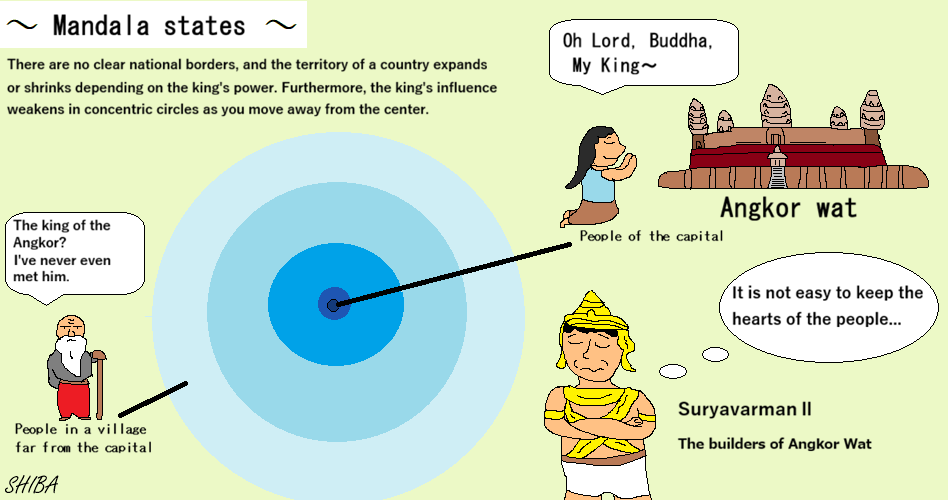
Under Suryavarman II, who built the temple, Angkor’s sphere of influence extended from what is now Thailand to southern Vietnam. He was the dominant figure of his age in Indochina, and Angkor Wat served as a monument symbolizing his power.
After Suryavarman II died, local regions became independent and Angkor’s territory contracted. However, Jayavarman VII, who emerged at the end of the twelfth century, gained popular support by developing infrastructure, including roads and hospitals. Under his rule, the Angkor Empire reached its greatest extent.
Elsewhere in twelfth-century Southeast Asia, many capable rulers made extraordinary efforts to win popular support. They included Kyansittha of Myanmar’s Pagan dynasty, who built countless temples and pagodas, and Lý Anh Tông(李英宗) of Vietnam’s Đại Việt(大越), who actively developed new farmland.
South Asia
In northern India, the Ghaznavid dynasty, a Muslim dynasty based in what is now Afghanistan, had frequently launched invasions since the eleventh century. By the middle of the twelfth century, the Ghurid dynasty, which had become independent from the Ghaznavids, began to expand. Although it eventually overthrew the Ghaznavids, it too continued invading northern India. Through these developments, Islam gradually spread into India and South Asia.
In southern India, the Chola dynasty, which had expanded into the islands of the Indian Ocean during the previous century, began to decline. Taking advantage of this situation, Parakramabahu I of Sri Lanka unified the entire island.
The Maldives, located farther south, was also freed from pressure by the Chola dynasty. In 1153, its ruler, Maharadun, abandoned Buddhism, the religion he had previously followed, and converted to Islam. It is believed that this conversion was intended to facilitate trade, since many of the merchants active in the Indian Ocean were Muslims. From that time onward, the rulers of the Maldives used the title “sultan” until the twentieth century.
Events
1115 Wanyan Aguda establishes the Jin dynasty.(East Asia)
Around 1120 Angkor Wat is constructed.(Southeast Asia)
1122 The Concordat of Worms temporarily settles the Investiture Controversy.(Europe)
1125 The Liao dynasty is destroyed by an invasion from the Jin dynasty.(East Asia)
1126 The Jingkang Incident. Emperor Huizong is captured by the Jin. Emperor Gaozong establishes the Southern Song.(China)
1130 The Kingdom of Sicily is established.(Italy)
1137 The Zagwe dynasty of Ethiopia overthrows the Kingdom of Aksum.
1142 The Treaty of Shaoxing. The Southern Song agrees to pay tribute to the Jin.(East Asia)
1143 The Kingdom of Portugal is established.
1147 The Almohad dynasty is established and the Almoravid dynasty is overthrown.(Morocco and the Iberian Peninsula)
1148 The Ghurid dynasty is established.(Afghanistan and India)
1153 Maharadun, king of the Maldives, converts to Islam.(South Asia)
1154 The Plantagenet dynasty begins. (England)
1156 The Hōgen Rebellion. Emperor Go-Shirakawa defeats the retired Emperor Sutoku.(Japan)
1156 The Duchy of Austria is established.(Central Europe)
1157 The Seljuk dynasty breaks apart.(West Asia)
1159 The Heiji Rebellion. Taira no Kiyomori defeats the Minamoto clan and seizes power.(Japan)
1167 Milan and other Italian cities form the Lombard League.
1168 The Ayyubid dynasty is established.(Egypt)
Around 1170 The philosopher Ibn Rushd serves the Almohad dynasty.(Morocco and the Iberian Peninsula)
1170 Military officials seize power.(Korea)
1171 Stefan Nemanja establishes the Nemanjić dynasty.(Balkans)
1181 Jayavarman VII ascends the throne, marking the height of the Angkor Empire.(Southeast Asia)
1185 The Battle of Dan-no-ura. The Taira clan is destroyed.(Japan)
1187 Saladin recaptures Jerusalem from the Crusaders.(West Asia)
1191 The Third Crusade takes place.(West Asia)
1192 Minamoto no Yoritomo is appointed shogun.(Japan)
1194 Khwarazm conquers the Seljuk dynasty.(West and Central Asia)
1196 The Choe military regime begins.(Korea)
1197 Levon I is officially recognized as king of the Armenian Kingdom of Cilicia.(West Asia)
(11th century) ← → (13th century(Japanese))