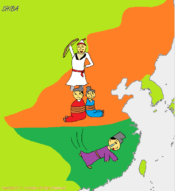
13th century The blue wolf of Mongolia



(12th century)← → (14th century(Japanese))
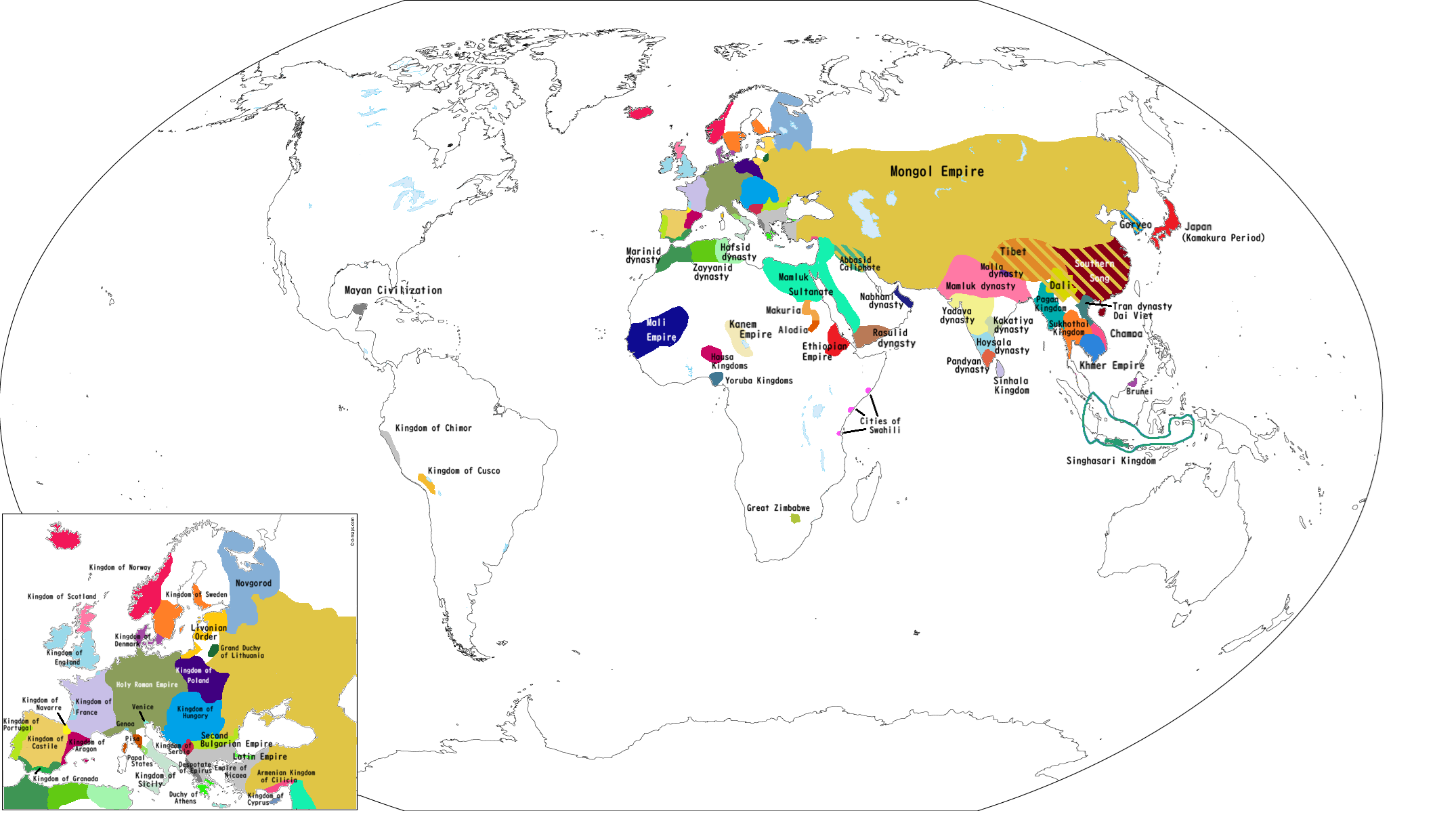
If there’s one thing that defines the 13th century, it has to be the rise of the Mongol Empire. The Mongols built an empire on a scale the world had never seen before. They reached their peak during this century, but began to decline in the 14th century.
Mongolia and Central Asia
In the grasslands of what is now Mongolia, nomadic states like the Xiongnu(匈奴) and the Göktürks(突厥) had existed since ancient times. But from the 9th century onward, these steppe peoples seem to have split into smaller groups and spent much of their time being pushed around by the Liao(遼) and Jin(金) dynasties. The charismatic leader who finally united them was Genghis Khan.
In 1206, Genghis Khan became the Great Khan—basically, the emperor. He quickly brought the different groups together and built a powerful nomadic state. He called it “Mongol,” which means “the strong.” Then he headed west.
For people used to racing across endless open plains, ideas like national borders and fixed territory didn’t really mean much. So the conquests just kept going, nonstop, until Genghis Khan died.
Across the interior of Eurasia ran a dry, sparsely wooded stretch of land known as the “Steppe Route,” which was also part of the Silk Road. With help from merchants who used this route, the Mongol Empire conquered rival powers one after another. In 1219, they invaded the Khwarazmian Empire, a major power in Central Asia, and brought it crashing down the following year (it was finally wiped out in 1231).
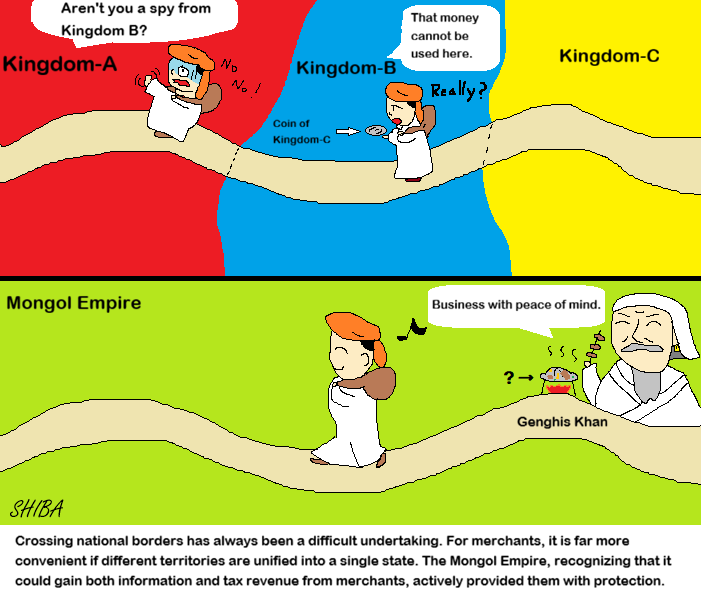
Genghis Khan died in 1227, but right after that, the Mongols conquered Western Xia(西夏) in western China. Under Ögedei Khan, who became the second Great Khan in 1229, they also conquered the Jin(金) dynasty in northern China.
By this point, the empire had grown several times larger. Ögedei built the capital of Karakorum right in the middle of the Mongolian plateau. He set up roads connecting the capital to the conquered lands and created the jamchi relay system—a kind of ancient infrastructure that let goods and information move fast.
Russia and Eastern Europe
After taking down the Khwarazmian Empire, the Mongols pushed into Russia and Western Asia. At the time, the lands of the Rus’ were divided among several states, but the main center was Kiev (Kyiv), now the capital of Ukraine. Russians and Ukrainians share the same ancestors: the Rus’ people.
In 1240, the Mongol army led by Batu—Genghis Khan’s grandson—reached Kiev and pretty much destroyed it. From then on, the Russians lived under Mongol rule for about 300 years. This period is known as the “Tatar Yoke.”
The next year, in 1241, the Mongols also attacked Poland and Hungary in Eastern Europe and dealt them some serious damage. But Ögedei died that year, so Batu turned around and headed back to Mongolia. Thanks to that, Europe—including Poland and Hungary—managed to escape conquest.
In 1246, Güyük Khan became the third Great Khan, but Batu didn’t get along with the new emperor. In the end, Batu never went back to Mongolia. Instead, in 1243, he set up his own regional government in Russia. This state is known as the Kipchak Khanate, or the Golden Horde.
Western Asia
The Seljuk Empire, a Turkic dynasty, had collapsed at the end of the 12th century. But in Anatolia—roughly present-day Turkey—one of its regional offshoots was still hanging on. This was the Sultanate of Rum (“Rum” means Rome, because Anatolia used to be part of the Byzantine Empire).
In the early 13th century, when the Byzantine Empire got hit by the Crusaders (more on that later), the Sultanate of Rum seized the chance and expanded its power across much of Anatolia. Since its territory touched both the Mediterranean and the Black Sea, it was sometimes called the “Sultan of the Two Seas.”
Kayqubad I, the sultan ruling this area in the 1220s, made good use of both seas, and the dynasty hit its peak. But in the 1240s, the Mongol army showed up here too. After losing, the Sultanate of Rum steadily lost its power.
As central authority weakened, smaller local rulers called “beys” started popping up all over Anatolia. One of them was Osman Bey—the man who would later lay the foundation for the Ottoman Empire.
Güyük Khan died in 1248, and Möngke Khan became the fourth Great Khan in 1251. Around this time, Hulagu—another grandson of Genghis Khan—invaded Western Asia. Baghdad, the region’s main center, still had the Abbasid caliph. But the Seljuks, who had once served as his bodyguards, were long gone, and they were way too weak to stop the Mongol army.
In 1258, Hulagu killed the caliph of Baghdad. With that, the Abbasid dynasty—after 500 years—was finished, both in name and in reality. Like Batu, Hulagu set up his own state in the region centered on present-day Iran and Iraq: the Ilkhanate (also called the Hulagu Ulus).
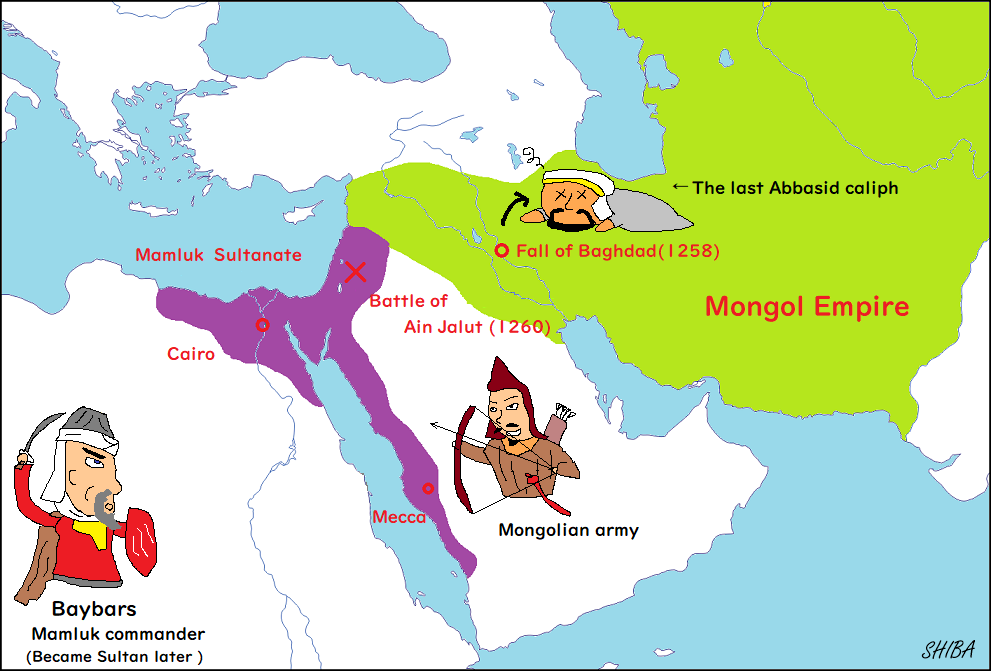
Around the same time in Egypt, the Ayyubid dynasty, which had fought hard against the Crusaders, lost power to the Mamluks—slave soldiers who had served under them. This was the birth of the Mamluk Sultanate in 1250. After Baghdad fell, the Mongol army clashed with the Mamluks too, but Möngke Khan had just died, and the main Mongol forces had already pulled back.
In the Battle of Ain Jalut in 1260, the Mamluk Sultanate, led by Baybars, won. That was where the Mongols’ momentum in Western Asia finally stopped. From then on, the Mamluk Sultanate and its capital, Cairo, took over from Baghdad as the center of the Islamic world.
Meanwhile, the Crusades, launched by Christians, were still going on. But by the end of the 13th century, the Mamluks had conquered every Crusader state except Cyprus. In the end, the Crusades failed. Still, contact between the Christian and Islamic worlds actually became more active.
China, Korea, Japan
At this time, Japan was right in the middle of the Kamakura(鎌倉) period. But not long after Minamotono Yoritomo(源頼朝) died, the Minamoto(源) clan fell apart due to political fighting. Emperor Go-Toba(後鳥羽上皇), who was running things from Kyoto through cloistered rule, saw a chance to take down the shogunate and attacked Kamakura. This was the Jōkyū Rebellion(承久の乱) of 1221.
But the shogunate side, with Hōjō Masako(北条政子/wife of Yoritomo) and others, won. After that, things stayed pretty stable under the Hōjō(北条) clan. It was also around this time that monks like Hōnen(法然), Shinran(親鸞), Dōgen(道元), and Nichiren(日蓮) created new schools of Buddhism. Still, the shadow of the Mongols was slowly creeping toward Japan too.
After destroying the Jin dynasty in 1234, the Mongols turned to the Southern Song(南宋) and Goryeo(고려/高麗). The Choe(최/崔) family, who controlled Goryeo through military rule, resisted, but in 1258 Goryeo submitted to the Mongols. That was the end of military rule. The Goryeo kings survived by marrying into the Mongol royal family.
Kublai Khan, who became the fifth Great Khan in 1260, attacked China while also absorbing Chinese culture and customs. In 1271, he gave his state a Chinese-style name: “Yuan” (元:the Great Yuan Ulus). He also took in writing and religion from Tibet, which he had brought under his control.
But at the same time, cracks within the Mongol royal family were getting bigger. In 1266, Kaidu—a grandson of Ögedei—rebelled after a power struggle with Kublai. Based in Central Asia, Kaidu pulled together the anti-Kublai factions and kept fighting.
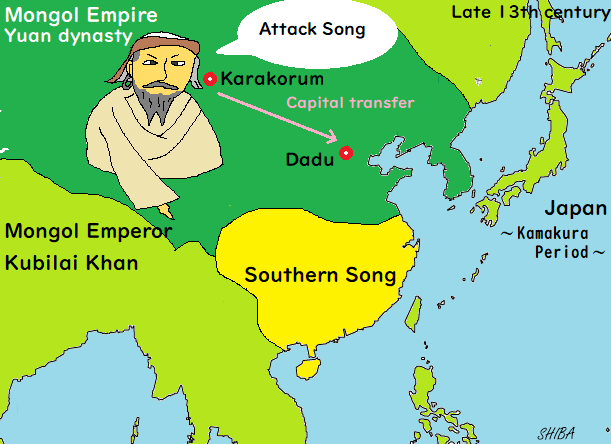
Amid all this, the Southern Song finally fell in 1279. Around the same time, the Mongol army also attacked Japan in the Mongol invasions (the Bunei(文永) and Kōan(弘安) campaigns). But the Mongols weren’t great at naval warfare, and many of their soldiers were subjects of the empire with low morale. With a little “help” from storms, Japan managed to fight them off.
Even so, by conquering China—a massive power—the Mongols became a truly giant empire. As mentioned before, they built roads to hold the empire together, and they developed sea routes too. With transportation getting easier on a global scale, the movement of people, goods, money, and information became more dynamic than ever.
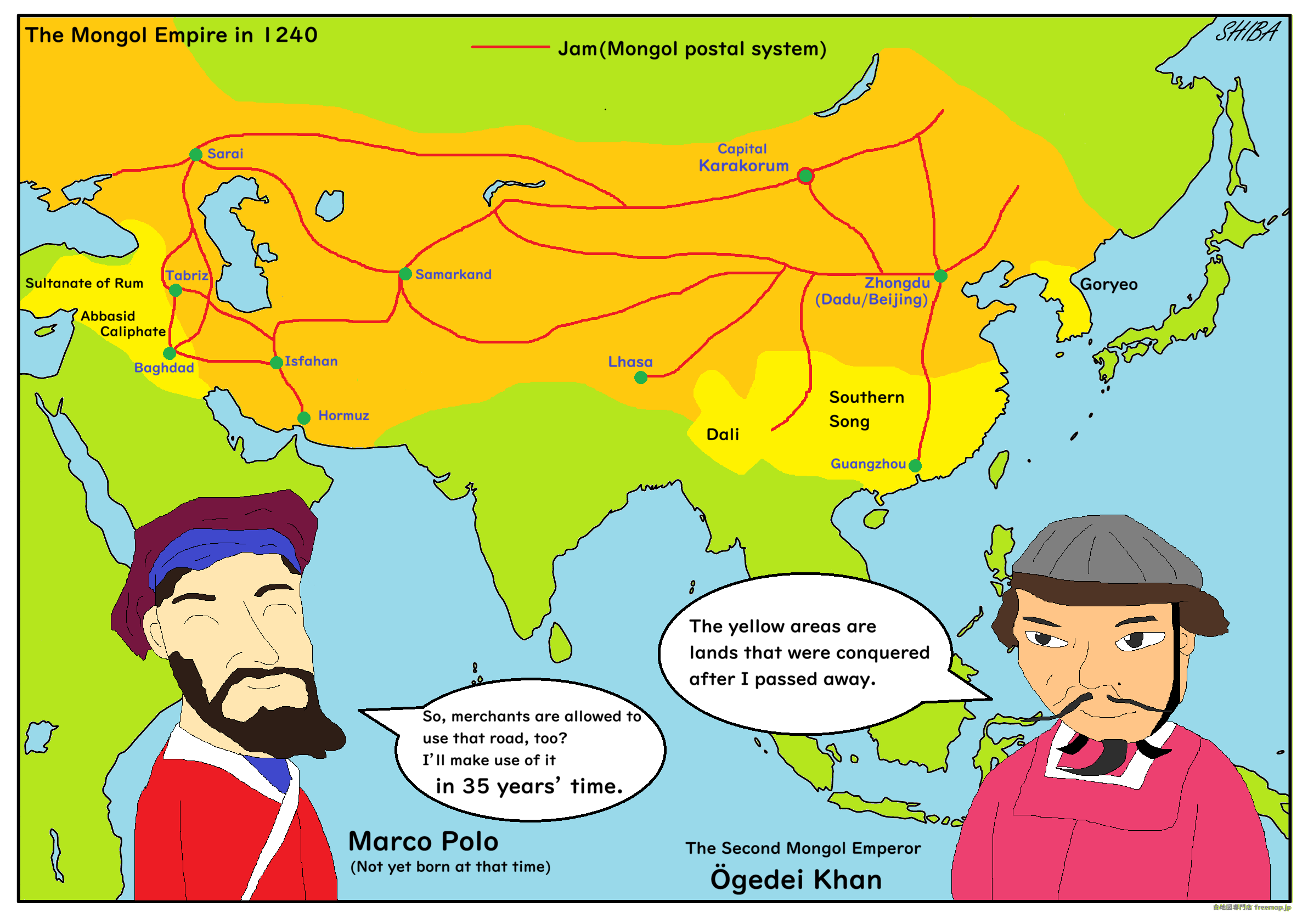
In terms of the economy, silver was used as a kind of “international currency.” But carrying heavy silver around was a pain, so to help with that, the world’s first paper money, called jiaochao(交鈔), was created.
In terms of technology, Islamic astronomy, which had developed in Western Asia, was brought to East Asia. Based on this, the scholar Guo Shoujing(郭守敬) created a new calendar, the Shoushi Calendar(授时历). Also, large amounts of blue pigment from Western Asia were brought in, revolutionizing Chinese ceramics. This was the birth of blue-and-white porcelain.
Going the other way, from East Asia to the West, gunpowder, the compass, and printing technology—the so-called Three Great Inventions, developed during the Song dynasty—were brought to Europe. Over the next 100 years or so, these technologies would completely transform European society.
Southeast Asia
While conquering the Song, Kublai of the Yuan also conquered the Dali(大理) Kingdom in Yunnan in 1253. Then he invaded Myanmar too. As a result, the capital of Pagan collapsed in 1277, but thanks to Burmese resistance, the country wasn’t fully conquered.
Influenced by these Mongol movements, some of the people living in inland China started moving south into the Indochinese Peninsula. The Thai, now one of the major ethnic groups in Southeast Asia, are thought to be a group that migrated on a large scale during this period. In the mid-13th century, the Thai set up a kingdom at Sukhothai in the Chao Phraya River basin and gradually took in the Buddhism practiced by the local people.
King Ramkhamhaeng, who ruled at the end of the 13th century, was the greatest king of the Sukhothai dynasty. There’s also a tradition that he created the Thai script still used today, though whether that’s historically true hasn’t been proven.
In northeastern present-day Thailand, the Lan Na Kingdom was established at the end of the 13th century. Its center was Chiang Mai.
In Vietnam, the Trần(陳) dynasty replaced the Lý(李) dynasty in 1225. This dynasty also got attacked by the Mongols, but thanks to military leaders like Trần Hưng Đạo(陳興道), they managed to force the Mongols to retreat.
On the island of Java in present-day Indonesia, King Kertanegara of the Singhasari Kingdom flat-out refused the Yuan’s demand to submit. So Kublai sent an expedition in 1292. But before the Yuan army even arrived, Kertanegara was assassinated in an internal conflict.
His son, Raden Wijaya, used the arriving Yuan army to fight the rebels, weakening both sides. Then, in 1293, he founded a new state: the Majapahit Kingdom.
So, in the end, all of the Mongols’ attempts to conquer Southeast Asia failed.
South Asia
India had more trouble with Islamic invasions than with the Mongol Empire. The Ghurid dynasty, which had invaded northern India, fell apart after its king was assassinated in 1206. Aibak, who had been his slave (mamluk), set up a new dynasty Mamluk Dynasty (defferent from the one of Egypt) with its capital in Delhi. This was the first step toward Delhi becoming India’s central city.
The Sinhala Kingdom on the island of Ceylon (Sri Lanka) started competing with the powerful Tambralinga Kingdom across the Bay of Bengal, on the Southeast Asian side, over control of sea trade. In 1247, the Tambralinga invaded Ceylon and temporarily took Jaffna in the north. Even after the Tambapanni army left, Jaffna stayed outside the control of the Sinhala Kingdom, breaking the island’s unity.
France, England, Germany, Switzerland
At the end of the 12th century, after Saladin took back Jerusalem, Christians kept sending Crusades. Pope Innocent III, active in the early 13th century, was one of the most powerful popes ever. He got involved in the Holy Roman Emperor’s “personnel decisions” and pushed kings around by threatening them with excommunication.
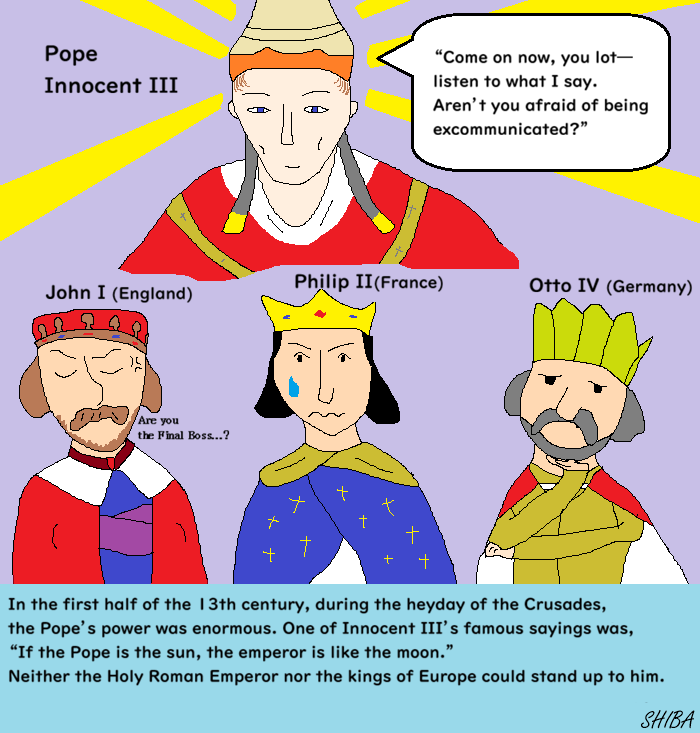
In France, in the early 13th century, King Philip II used political marriages and various maneuvers to take a lot of land from the nobles. This included land belonging to King John I of England. He also pulled off the Albigensian Crusade against the Cathars, a Christian sect seen as heretical that had spread across southern France, and expanded his control over the region. His successor, Louis IX, made a name for himself in the Seventh and Eighth Crusades and boosted the king’s authority.
On the cultural side, Scholasticism, which interpreted Christianity through Greek philosophy, developed. Its biggest name, the theologian Thomas Aquinas, who wrote the massive Summa Theologica, was Italian by birth but was active at the University of Paris.
In England, King John I, who had been excommunicated by Innocent III at one point, lost a lot of land to Philip II, as mentioned above. He wanted to start a war with France to get it back, but the local feudal nobles said no. In 1215, he was forced to accept the Magna Carta, which spelled out the nobles’ rights.
But the fighting between the English kings and the nobles didn’t stop. In 1265, the noble Simon de Montfort rebelled and held his own parliament. King Henry III was even temporarily taken prisoner. The nobles’ power became a real threat, so the monarchy started taking parliament more seriously.
Edward I, who succeeded Henry III, worked to expand English control over the island of Britain. In 1283, Wales was folded into the Kingdom of England. That’s also when the heir to the English throne started being called the “Prince of Wales.”
Edward I then put pressure on the Kingdom of Scotland to the north. Scotland, in trouble, asked France—England’s rival—for help. Facing two enemies, Edward I opened Parliament in 1295 to get approval to raise money from the citizens for the war. This parliament included not just nobles but also representatives of merchants and farmers. Because it became a model for later parliaments, it’s called the “Model Parliament.” But even so, England couldn’t bring Scotland under control this time.
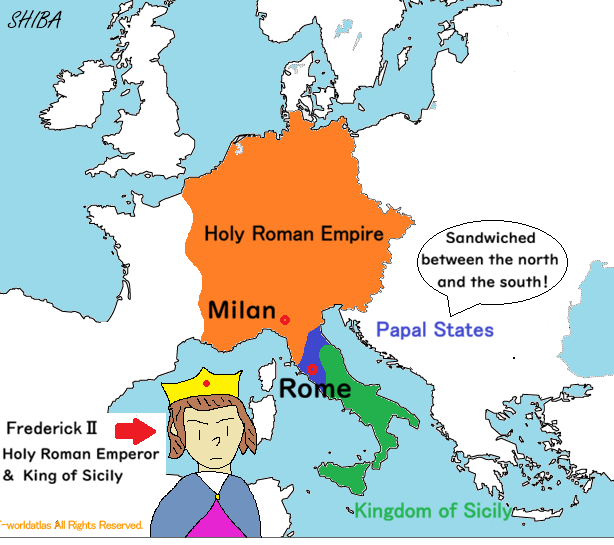
In Germany (the Holy Roman Empire), Otto IV was on the throne in the early 13th century. But he also clashed with Pope Innocent III and got excommunicated. In 1215, Frederick, king of the Kingdom of Sicily in southern Italy, took the throne as Frederick II.
But this meant the Papal States were now squeezed between Germany and southern Italy, both effectively ruled by Frederick II. After Innocent III died in 1216, the popes seem to have been scared of him. They started threatening him with excommunication again, saying, “Hurry up and go on a Crusade!”
In 1229, Frederick II went on the Fifth Crusade and, through negotiations with the Ayyubid dynasty, got Jerusalem back for the Christians. Sicily had been under Islamic rule for a long time, so the emperor probably didn’t have much of a problem talking with these “infidels.” (Jerusalem was taken back by the Muslims again in 1244.)
Even after coming home, Frederick II kept fighting with the pope. During this time, he gave the German princes privileges over taxes and courts to keep them from getting angry. So when Frederick II died in 1250, the emperor’s power dropped even further. From 1256 to 1273, the empire went through the “Great Interregnum,” a period with no real emperor. After that, the Habsburg family, which at the time was just a minor noble house nobody paid much attention to, started eyeing the imperial throne.
Even though Germany wasn’t doing much politically, its economy kept growing. Germans expanded along the Baltic coast, pushing trade and spreading Christianity. It was also in the 13th century that Germans founded Riga, now the capital of Latvia, and Tallinn, now the capital of Estonia, in the present-day Baltic states. To protect these trading areas, the cities of northern Germany, centered on Lübeck, gradually got closer together.
There were also people who used the fact that Frederick II controlled both Germany and Sicily to their advantage. That would be present-day Switzerland. At the time, this area was also part of the Holy Roman Empire, but local nobles like the Habsburgs were ruling the local peasants pretty harshly.
So the peasants came up with a plan: get their land turned into direct imperial territory, then use that to win autonomy. Around this time, a route over the Alps connecting Germany and Italy opened up, so it was also in the emperor’s interest to control this area. In the first half of the 13th century, regions like Schwyz and Uri got charters of liberty from the emperor.
Later, when the Habsburg family started going after the imperial throne, the territories that had gotten charters banded together to resist. In 1291, the three regions of Schwyz, Uri, and Unterwalden formed an eternal alliance. This became the seed of Switzerland.
Italy and the Byzantine Empire
The Fourth Crusade, called for by Pope Innocent III, was carried out with help from the Republic of Venice, which had become the go-to experts on Mediterranean trade. But the Crusade ran out of money and couldn’t even leave the Mediterranean, let alone reach Jerusalem. Instead, they started looting along the way. This got tangled up with a succession dispute in the Byzantine Empire, and in 1204, the Crusaders attacked and took Constantinople. The Byzantine Empire temporarily collapsed, and the Latin Empire was set up.
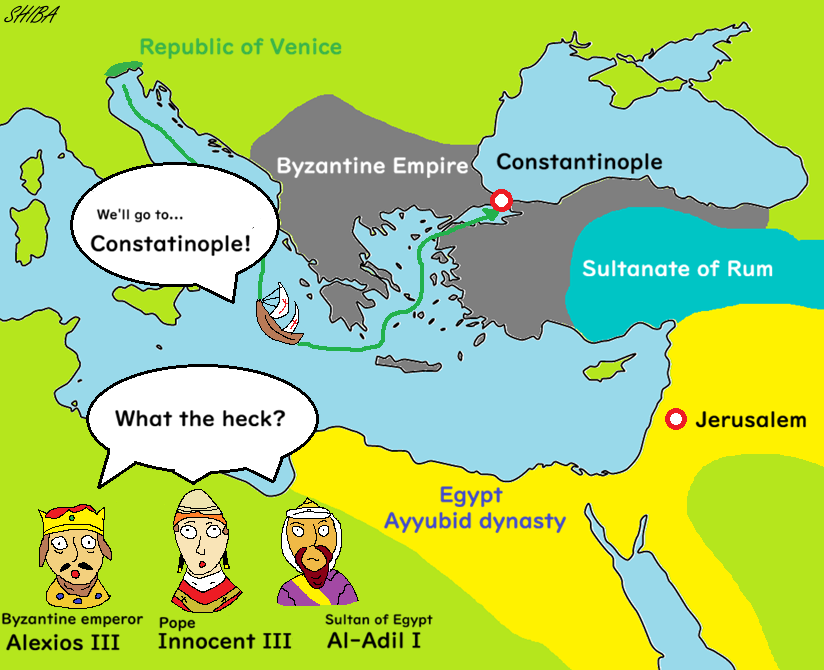
The remaining Byzantine forces scattered and set up governments in exile. One of them, the Empire of Nicaea, founded on the western side of the Anatolian plateau, kept its strength by building economic ties with the neighboring Sultanate of Rum to the east. In 1261, they brought the Byzantine Empire back. But even though this empire would last another 200 years or so, it never got back its old glory.
Venice, which played a big part in setting up the Latin Empire, gained indirect control over Crete and other parts of present-day Greece, and did a lot of trade with Egypt across the sea. On top of that, the rise of the Mongol Empire massively expanded Venice’s commercial reach. The reason Marco Polo, a Venetian merchant, visited the Mongols during this period was also because of Venice’s wide commercial network.
The growth of trade boosted the economies of other northern Italian states—Milan, Pisa, Florence, and more—and technologies and ideas from Asia started flowing in.
On the other hand, in the Kingdom of Sicily in southern Italy, not much of this was happening. When Frederick II died in 1250, the pope tried to put another royal family on the Sicilian throne to cut it off from Germany. The pick was the French House of Anjou, and in 1266, Charles of Anjou actually became king of Sicily.
But Charles’s rule wasn’t popular with the locals. In 1282, the “Sicilian Vespers” happened, where a lot of French soldiers under his command got massacred. Sicily then asked the Kingdom of Aragon in Spain for help. So the Kingdom of Sicily split in two: the island of Sicily went under Aragonese rule, while the Anjou family’s territory was limited to the mainland centered on Naples.
Iberian Peninsula, Morocco, and Africa
On the Iberian Peninsula, the kingdoms of Castile and Aragon kept pushing the Reconquista. In particular, their win over the Almohad forces of Morocco at the Battle of Las Navas de Tolosa in 1212 was a big deal. After that, the Almohads pulled out of the Iberian Peninsula. By 1232, the Islamic dynasty was left with just the area around Granada in the south (the Nasrid dynasty).
Even so, a lot of Muslims were still living on the Iberian Peninsula, and activities like translating Islamic texts into Latin, which had been going on since the last century, got even more active. But over time, Christians started pressuring these “infidels”—not just Muslims but also Jews—into leaving or converting.
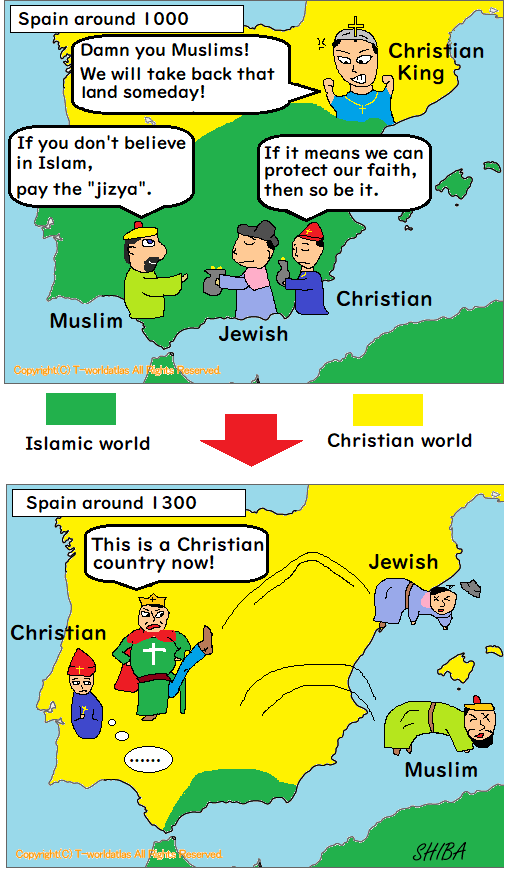
Meanwhile, the Almohad dynasty later split apart and kept declining, and in 1269 it was taken down by the Marinid dynasty. The Marinids also invaded the Iberian Peninsula but didn’t manage to take any land.
In Ethiopia, around 1270, the Solomonic dynasty was founded by Yekuno Amlak. Because he claimed to have revived a dynasty going back to before the Common Era, it’s often called the “Restored Solomonic dynasty.” Despite a lot of ups and downs, this dynasty amazingly lasted until the 1970s.
In southern Africa too, real cities started appearing around this time. Among them, “Great Zimbabwe,” built with huge stones, is thought to have been the biggest city in southern Africa at the time, with a population over 10,000. The present-day Republic of Zimbabwe in Africa also gets its name from these ruins.
Events
1204 Fourth Crusade. The Latin Empire is set up in Constantinople. (Eastern Europe)
1206 Genghis Khan takes the throne; the Mongol Empire is founded. (Mongolia)
1206 Aibak founds an Islamic dynasty (the Slave Dynasty) in Delhi. (India)
1209–1229 The Albigensian Crusade. (Western Europe)
1215 John accepts the Magna Carta, which spells out the nobles’ rights. (England)
1220 The Mongols destroy the Khwarazmian Empire. (Central Asia)
1221 The Jōkyū Rebellion. The Kamakura shogunate, led by Hōjō Masako and others, beats Emperor Go-Toba. (Japan)
1222 The Singhasari Kingdom is founded. (Indonesia)
1225 The Trần dynasty is founded. (Vietnam)
1232 The Nasrid Kingdom of Granada is founded. (Iberian Peninsula)
Around 1235 The Mali Empire is founded. (Sahara region, Africa)
1227 The Mongols destroy Western Xia. (East Asia)
1234 The Mongols destroy the Jin dynasty. (East Asia)
1240 The Mongols destroy Kiev. (Russia and Ukraine)
1241 The Battle of Legnica (Wahlstatt). The Mongols beat the Polish army. (Eastern Europe)
1243 Batu of the Mongols founds the Golden Horde (Kipchak Khanate).
1250 The Ayyubid dynasty falls; the Mamluk Sultanate is founded. (Egypt)
1252 The Goryeo Tripitaka is completed. (Korean Peninsula)
1256–1273 The Holy Roman Empire goes through the Great Interregnum. (Germany)
1258 Hulagu of the Mongols destroys the Abbasid dynasty and founds the Ilkhanate (Hulagu Ulus). (Middle East)
1259 Military rule ends; Goryeo submits to the Mongols. (Korean Peninsula)
1259 The Latin Empire falls; the Byzantine Empire is restored. (Eastern Europe)
1260 The Battle of Ain Jalut. Baybars of the Mamluk Sultanate beats the Mongol army. (Middle East)
1265 The Simon de Montfort Parliament. (England)
1266 The Kaidu Rebellion begins. (East Asia)
1270 The Sambyeolcho Rebellion. (Korean Peninsula)
1271 Kublai Khan founds the Yuan dynasty (Great Yuan Ulus). (China)
Late 13th century The Venetian merchant Marco Polo visits the Yuan and serves Kublai. (Mongolia)
1274 The first Mongol invasion of Japan (Bunei campaign). (Japan)
1277 The Mongols destroy the Pagan Kingdom. (Myanmar)
1279 The Mongols destroy the Southern Song. (China)
1281 The second Mongol invasion of Japan (Kōan campaign). (Japan)
1282 The Sicilian Vespers. King Peter III of Aragon also becomes king of Sicily. (Spain and Italy)
1291 The Mamluk Sultanate takes Acre, the last Crusader stronghold, ending the Crusades. (Western Asia)
1291 The alliance of Uri, Schwyz, and Unterwalden is formed in Switzerland.
1293 Raden Wijaya of Java beats back the Mongol Empire and founds the Majapahit Kingdom. (Indonesia)
1299 Osman I takes the throne. (Western Asia)
(12th century)← → (14th century(Japanese))