Köppen-Geiger climate classification



In Japan, the blooming of cherry blossoms signals the arrival of spring. It is not just cherry blossoms; Japan’s four distinct seasons are clearly reflected in the changing appearance of its vegetation. However, looking globally, there are many places with different climates. In this piece, we will explore the climates found in various parts of the world.

cherry blossom in my neighborhood
The Köppen-Geiger Climate Classification
While some places like Japan enjoy four distinct seasons, other corners of the world experience seasons differently. Think of Hawaii with its endless summer, tropical regions that only know “wet” and “dry” seasons, or Antarctica where it remains below freezing even in summer.
In the 19th century, a German climatologist named Wladimir Köppen studied the global distribution of plants and used them to categorize the world’s climates. This system divides the world into five major climate zones, assigned with the letters A through E: Tropical (A), Dry (B), Temperate (C), Continental (D), and Polar (E). (While Highland climate (H) is sometimes added for high altitudes, we’ll skip it for now.)
To put it very simply: A jungle canopy, a desert cactus, and a Siberian pine forest are all plants—but they are completely different worlds. That’s the core idea here.
The criteria for these boundaries are calculated using temperature and precipitation, the two most crucial factors for plant growth. Simply put, if a place is too cold for trees to grow, it’s Polar. If it’s too dry for trees to grow, it’s Dry.
Let’s take a closer look at each zone, starting from the equator.
A: Tropical Climates
Why does the alphabet start with “A” at the equator? Because the system radiates outward. Starting from the equator (0° latitude), the climate zones generally spread out toward the poles in alphabetical order: A, B, C, D, and E.
When you think of the tropics, you probably picture a lush jungle. Indeed, “A” climates are found right around the equator, where it is hot and rainy. However, some tropical areas have distinct wet and dry seasons. Thus, the Tropical zone is split into three main subcategories:
Af (Tropical Rainforest Climate)
Hot year-round with frequent, dramatic downpours (squalls). This is the classic jungle environment. Places like Singapore, Sumatra, central Africa, the Amazon basin, and Hawaii fall into this category.
Aw (Tropical Savanna Climate)
Hot all year, but with a stark contrast between seasons—heavy rains during the wet season, and virtually none during the dry season. It acts as a buffer between rainforests and deserts. You can find this in parts of Thailand, India, Kenya, and most of Brazil.
Am (Tropical Monsoon Climate)
The middle ground between Af and Aw, featuring a brief, weak dry season. Think of Java in Indonesia, parts of Myanmar, and the Florida peninsula in the US.

(Visual tip: A savanna is basically a vast grassland dotted with occasional trees.)
B: Dry Climates
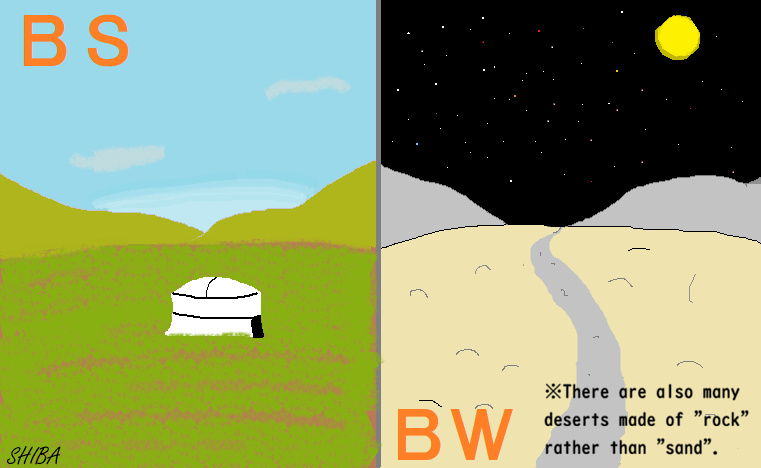
These are regions with very little rainfall. While the Sahara Desert might come to mind first, not all dry climates are barren sand dunes. Some are vast grasslands where the lack of water prevents large trees from growing, but allows shorter vegetation to thrive.
BS (Steppe Climate)
“Steppe” means grassland. Picture the vast Mongolian plains. Because there is a tiny amount of rain, hardy grasses can survive. This climate is famous for nomadic herding (cattle, horses, sheep). Historically, this continuous belt of grassland stretching from Mongolia through Central Asia and Ukraine was known as the “Steppe Route”—the very foundation upon which Genghis Khan built his massive empire.
BW (Desert Climate)
This is where it seriously doesn’t rain. Famous deserts like the Sahara, the Namib, and the Rub’ al Khali in Arabia belong here. There are a few reasons why these deserts exist:
High Pressure Belts: Around 30° North and South latitude (e.g., Egypt, Saudi Arabia, Australia), the air is constantly sinking, preventing cloud formation.
Continentality: Central Asia is so incredibly far from any ocean in every direction that moisture-laden winds simply cannot reach it.
Cold Ocean Currents: Along the coast of Peru (near the Nazca Lines) and the Namib Desert, cold ocean currents cool the air from below, preventing the rising air currents needed to make rain.
C: Temperate Climates
These are the mild, comfortable regions of the world. In a way, they are the most hospitable places for human civilization. Temperate zones include Japan, parts of China, Europe, and the United States—all areas with high population densities. This zone is highly diverse, with four major subcategories:
Cfa (Humid Subtropical Climate)
The “f” means rain falls year-round, while the “a” indicates hot summers. In short, it features hot summers, cold winters, and plenty of rain in all seasons. It is commonly found on the eastern sides of continents, heavily influenced by monsoons—such as Tokyo, New York, Shanghai, Buenos Aires, and Sydney.
A note on Japan: Nationally, the climate varies wildly between the Pacific side and the Sea of Japan side. In winter, the Sea of Japan side becomes one of the snowiest places on Earth, while the Pacific side is hit by dry, biting winds. Yet, on a global scale, the whole country is lumped into the same “consistently rainy” Cfa category!
Cfb (Marine West Coast Climate)
Compared to Cfa, this climate has a much narrower temperature range between summer and winter. It is found on the western sides of continents, where westerly winds blow mild ocean air inland year-round. Western Europe (UK, France, Germany) and New Zealand are classic examples. In fact, New Zealand’s famous sheep farming industry thrived partly because British settlers found a climate that perfectly matched home.
Cs (Mediterranean Climate)
The “s” stands for summer dry. As the name suggests, this covers the lands surrounding the Mediterranean Sea. It is famous for crops that can withstand summer droughts, like olives, grapes, oranges, and cork oak. This is why countries like Italy, southern France, Spain, Greece, and Turkey are world-renowned for wine and olive oil. Outside of the Mediterranean, you can find this in Cape Town (South Africa), California (US), and parts of Chile.
Cw (Subhumid Temprate Climate)
The “w” stands for winter dry. The exact opposite of Cs, this climate sees extreme dryness in the winter. It is essentially a cooler version of the Aw (Savanna) climate, spreading across southern China, northern India, and parts of the South American highlands. Summers are hot and rainy, making it ideal for growing tea and rice.

D: Continental Climates
If a region experiences winter temperatures that drop below freezing and stay there for a significant period, it belongs here. However, summers can get surprisingly warm—sometimes creating a dramatic temperature swing of over 50°C between seasons. The vegetation is dominated by taiga—vast coniferous forests. The pine trees we use for Christmas trees are a perfect example. Because the Southern Hemisphere lacks large landmasses at these latitudes, this climate exists almost exclusively in the Northern Hemisphere.
Df (Humid Continental Climate)
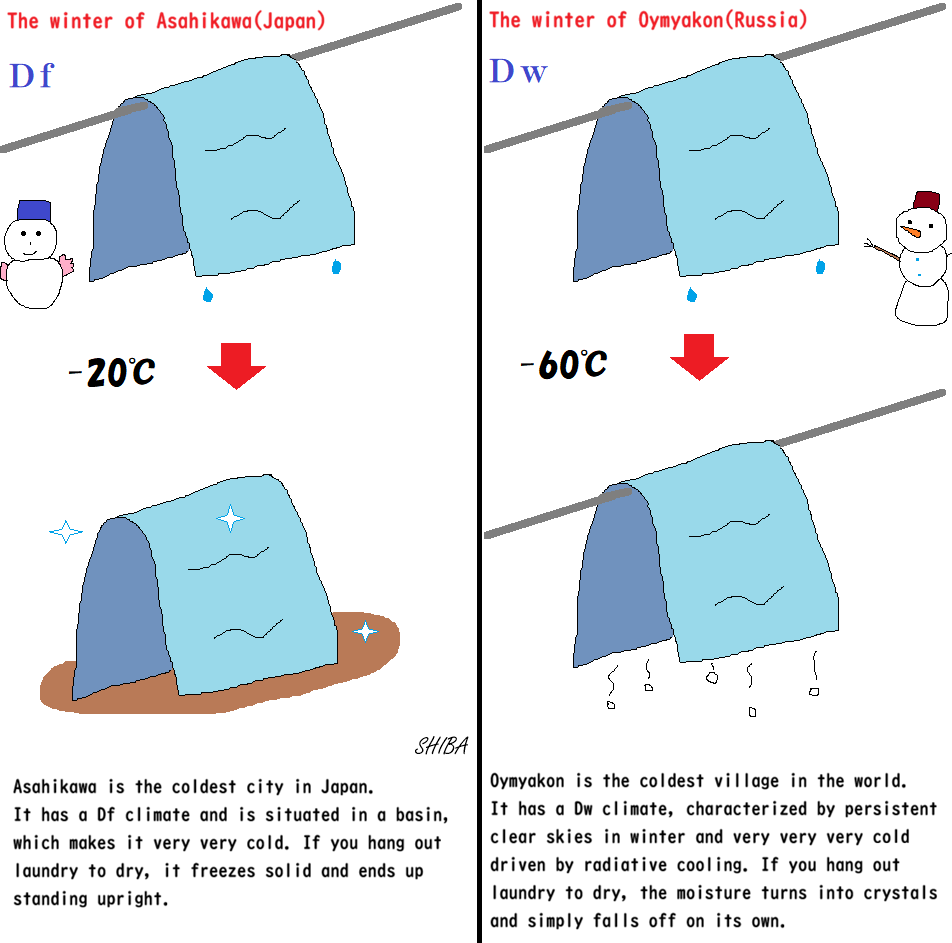
Winters are bitterly cold, but summers get reasonably warm, with consistent rain or snow throughout the year. It covers regions with distinct winter identities, such as Hokkaido (Japan), western Russia (Moscow), Canada, and Scandinavia.
Dw (Monsoon Continental Climate)
As the name implies, winters here see very little snowfall, but intense radiational cooling creates some of the most brutal drops in temperature on Earth. This is home to the “Pole of Cold”—the coldest permanently inhabited places on the planet. Eastern Siberia dominates this zone, including Oymyakon, famously known as the coldest village in the world. It also includes cities like Beijing, which hosted the 2022 Winter Olympics.
E: Polar Climates
Here, temperatures stay below freezing for most or all of the year. Because it is nearly impossible for plants to grow, you won’t find large cities or civilizations here. Yet, indigenous cultures like the Inuit have adapted to these extreme environments for centuries, proving the incredible resilience of humanity.
ET (Tundra Climate)
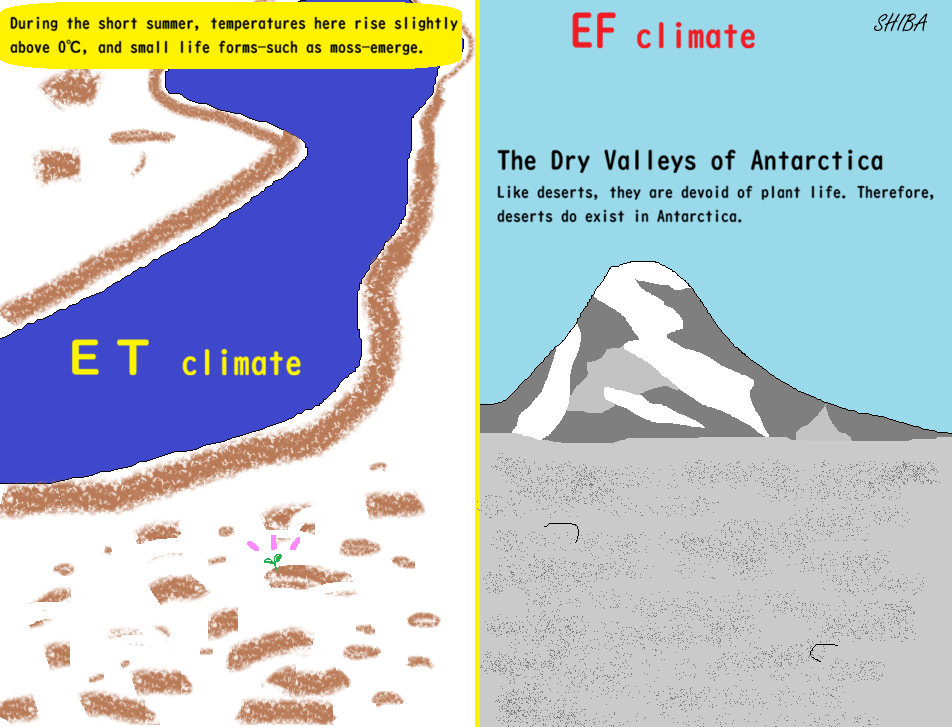
(No relation to the famous alien!) This climate marks the absolute limit of human habitability. For a brief period during the short summer, temperatures crawl just above 0°C , allowing mosses and lichens to grow. You can find this in the northernmost fringes of Russia, Alaska, Canada, Iceland, and the absolute southern tip of South America.
EF (Ice Cap Climate)
A world of perpetual frost where temperatures never rise above freezing. Greenland and Antarctica are the icons of this climate. It is fundamentally uninhabitable for humans, and even polar bears and penguins stick close to the coastlines where the ocean provides food.
Looking at the Map…
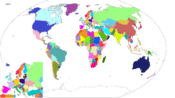
When you put it all together, the world looks like this:
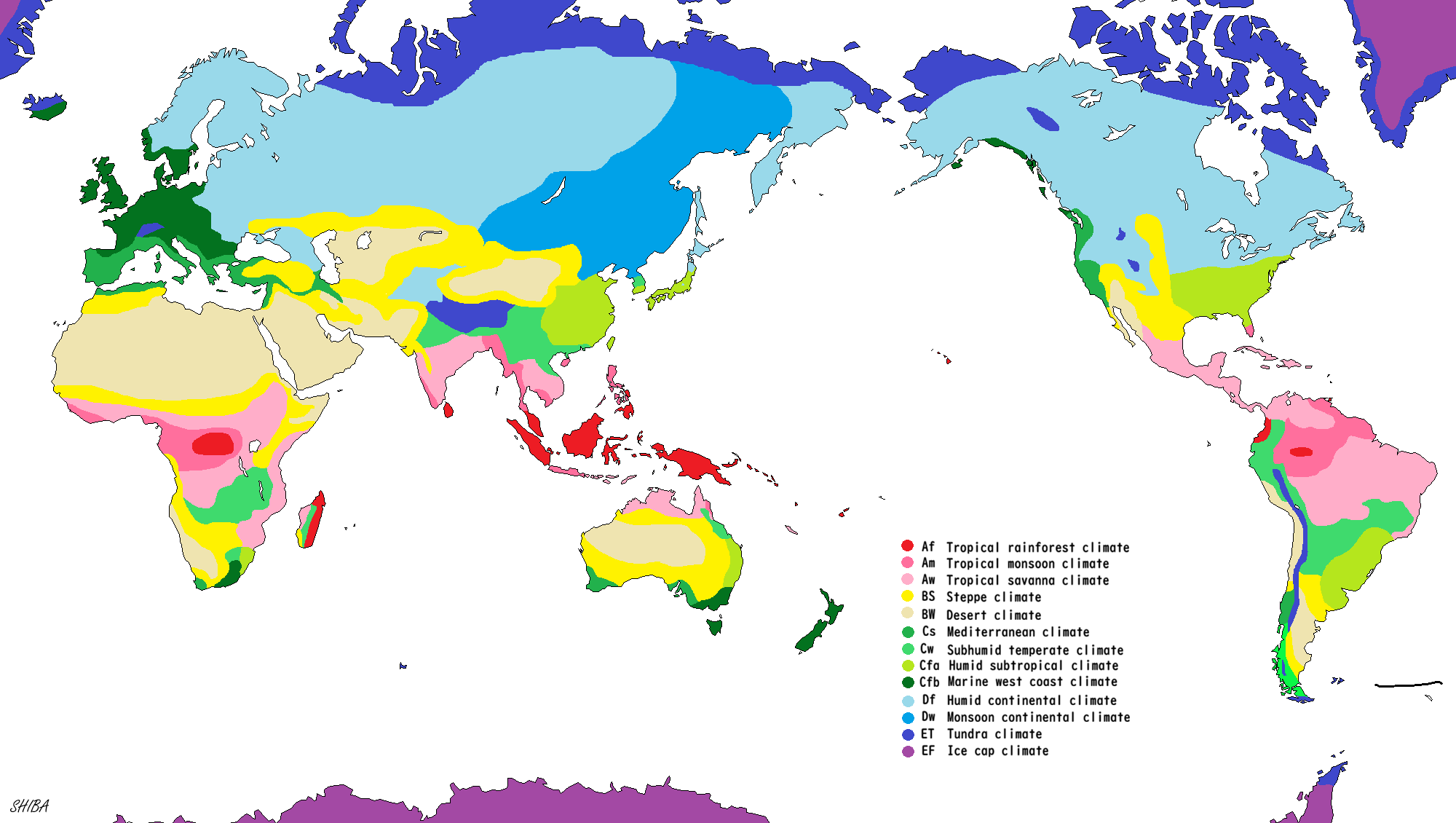
When you look at a map divided not by political borders, but by temperature and rainfall, doesn’t the world look completely different?