10th century Challenging those in power


9th century ← → 11th century(Japanese)
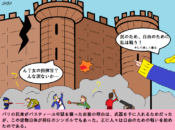
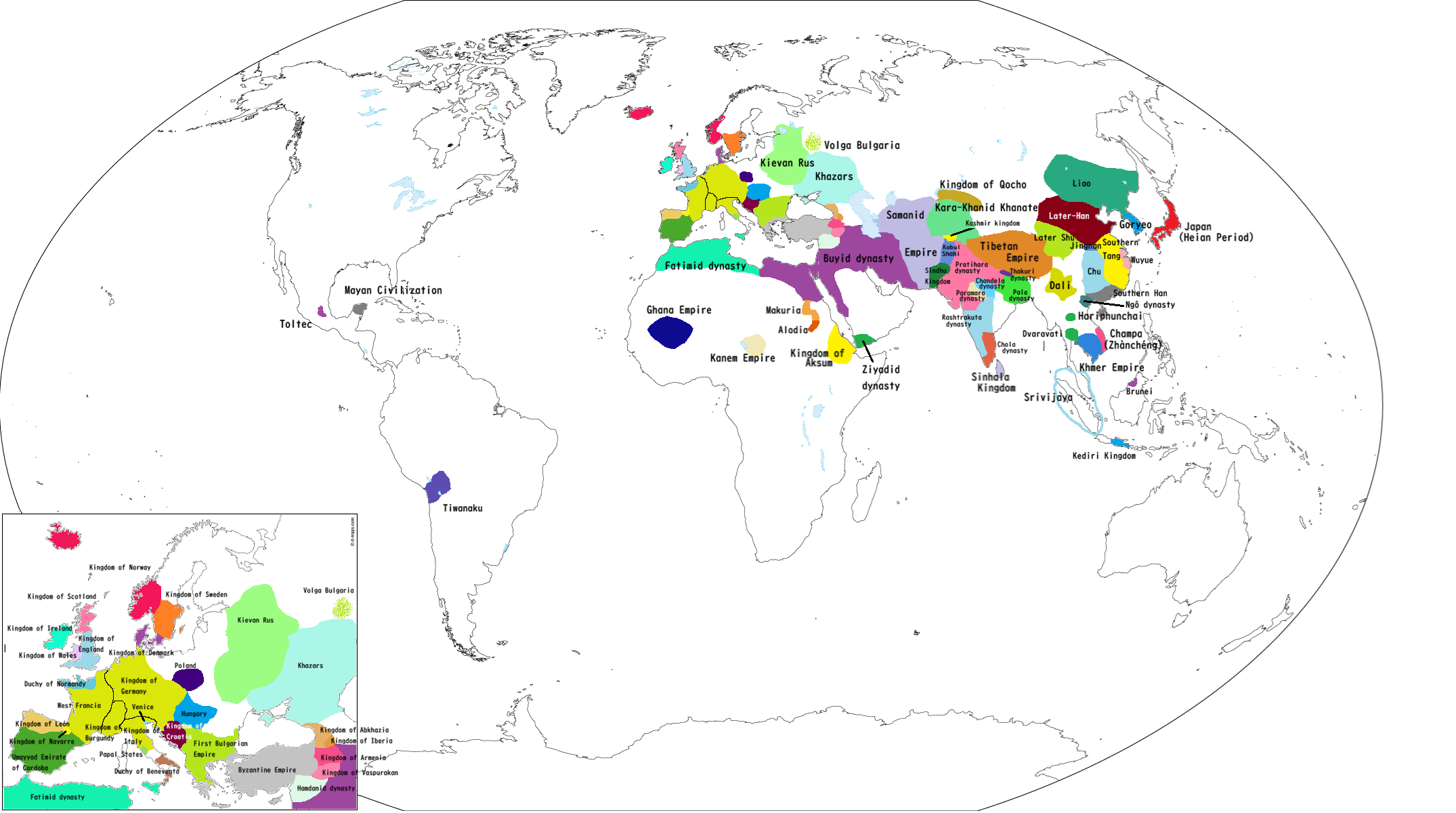
When the 10th century began and the thousandth year since the birth of Christ was approaching, great changes were underway. In the East, the vast Chinese Tang dynasty disappeared, while in the West the Abbasid caliph in Baghdad became little more than a figurehead. Challenging these old powers were ambitious regional regimes that had once been their subordinates.
Japan
In Japan, aristocrats led by the Fujiwara(藤原) clan came to dominate politics by serving as regents (sesshō/摂政) and chief advisors (kanpaku/関白). They married their daughters to emperor s (Tenno/天皇) and then placed the children from those unions on the throne. This made them grandfathers of reigning emperors and gave them immense authority. The regent acted in place of a child emperor, while the kanpaku “assisted” adult emperors, though in practice they controlled the heart of government. The Fujiwara monopolized these posts.
In the provinces, officials called zuryō(受領) were dispatched to collect taxes. Some abused the distance from the capital, arbitrarily inflating tax demands and lining their own pockets. To protect themselves from such abuses, local landowners donated their lands to high-ranking nobles, placing them under noble protection. These donated estates, or “shōen“(荘園), became private manors, and their numbers grew. To defend these lands, armed groups emerged, and these are regarded as the origins of the warrior class, the samurai.
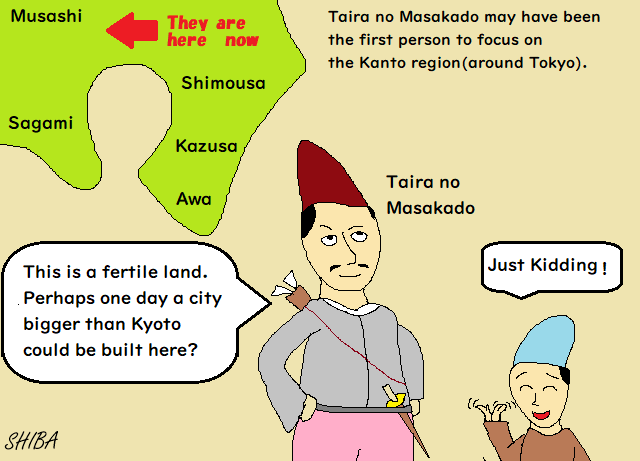
The most famous example is Taira no Masakado(平将門). Around 930, he governed the region of Bandō (坂東/ roughly today’s Kantō関東) and clashed with provincial officials, eventually rising in rebellion. He went so far as to call himself “new emperor” and turned against the central government in Kyoto. Although the rebellion was quickly suppressed, his uprising foreshadowed the coming age of the samurai.
China
Shaken by the Huang Chao Rebellion (黃巢之乱), the Tang(唐) dynasty was finally destroyed in 907 by the military governor Zhu Wen (朱溫). His own regime, however, was unstable, and five short-lived dynasties rose and fell in quick succession in northern China. In the south, about ten small states appeared and disappeared. For this reason, the period is known as the “Five Dynasties and Ten Kingdoms(五代十國).”
While China was divided and in turmoil, a nomadic people called the Khitan(契丹), living in the northeast, expanded their power. Their leader Yelü Abaoji(耶律阿保机) took the imperial title and founded a dynasty later known as Liao(遼). In 926, they destroyed Balhae (渤海), which had ruled the northern part of the Korean Peninsula and Manchuria.
In 936, one of the Five Dynasties, Later Jin(後晋), ceded the strategically vital region known as the Sixteen Prefectures of Yan and Yun (燕雲十六州:around present-day Beijing) to the Khitan in return for military support and stability. From the Chinese perspective, this territory lay “inside” the Great Wall. This transfer allowed the nomads to step directly into the Chinese agricultural heartland.
China’s reunification was carried out by the Song (Northern Song/北宗) founded by Zhao Kuangyin(趙匡胤). It was completed in 979 under the second emperor, Taizong (太宗: not to be confused with the Tang emperor of the same temple name). Under the Song, the powerful military governors of Tang times were replaced by civil officials chosen through the imperial examinations. The Song is therefore often described as a “civilian-ruled” dynasty, though its military strength was still among the most formidable in the world.
In the south, in present-day Yunnan, the Kingdom of Dali(大理) arose. The region produced fine white stone that became a specialty product — the marble that still bears its name.
Korean Peninsula
As the Tang collapsed, the Korean Peninsula also underwent dynastic change. Silla(신라/新羅) had grown weak, and descendants of the old kingdoms it once conquered — Goguryeo(고구려/高句麗) and Baekje (백제/百濟) — founded T’aebong(태봉/泰封) and Later Baekje(후백제/後百濟) in hopes of restoring their ancestral states.
Among them, Wang Geon(왕건/王建) of T’aebong renamed his state Goryeo(고려/高麗) and in 935 forced Silla’s last king to abdicate, bringing Silla to an end. The following year he conquered Later Baekje as well, reunifying the peninsula under Goryeo.
Goryeo moved toward stability under its fourth king, Gwangjong(광종/光宗), who took the throne in 949. During the wars from Silla to Goryeo, many captives had been turned into slaves by powerful local families. Gwangjong issued the Slave Review Edict(노비안검법/奴婢按檢法) to investigate such cases and free those enslaved unjustly. In 958 he introduced a civil service examination modeled on the Chinese system, and in 962 he established tributary relations with the Northern Song, which in turn recognized Goryeo’s status. These measures curbed the power of the great clans and strengthened the royal house.
Over time, Goryeo’s bureaucracy became firmly established. Officials on the peninsula were divided into civil officials (munban), who handled administration, and military officials (muban), who oversaw defense; together they formed the elite known as the yangban. In 976, a system called jeonsigwa was introduced to grant land to these officials.
Southeast Asia
In Southeast Asia, some states broke away from Chinese rule. One such place was present-day Vietnam. From the 1st century BCE, Vietnam had been under Chinese control for roughly a thousand years. During that time it became an important transit hub for trade in the Indochina region. In the 10th century, it finally achieved independence.
The Vietnamese called themselves “Viet,” and the ruler Đinh Bộ Lĩnh, who took the imperial title, named his realm Đại Cồ Việt. This name, however, did not last long; in the early 11th century it was changed to Đại Việt.
In Cambodia, the Angkor dynasty repeatedly split and reunited but steadily expanded its territory.
On the island of Java in Indonesia, the Mataram kingdom of the Sanjaya dynasty unified the island. After volcanic eruptions and other upheavals, the capital was moved eastward to Kediri in 928, and the kingdom is known as the Kediri dynasty. While maintaining tributary relations with the Northern Song, the Kediri court also developed ties with India and China; during this period, Indian epics such as the Mahābhārata were adapted into distinctly Javanese forms.
In the region of the Strait of Malacca, between Sumatra and the Malay Peninsula, numerous port towns emerged. This federation of port-city polities is referred to in Chinese sources as “Sanfoqi(三仏斉).” This state has long been regarded as a revival of Srivijaya, which had once existed in the same area, but many scholars now dispute this view, and the exact relationship remains unclear.
Middle East and the Iberian Peninsula
The Abbasid Caliphate, with its capital at Baghdad, was ruled by a sovereign who, as caliph, was regarded as the supreme leader of Islam.
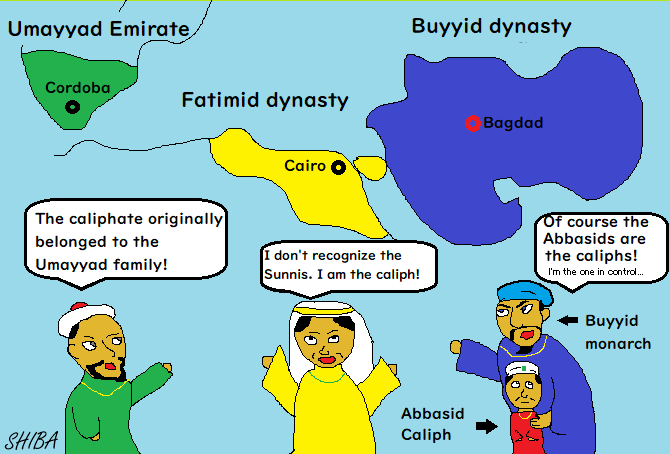
By the 10th century, however, the Abbasid caliphs had lost real power, and two trends emerged. First, some dynasties began to rule in the caliph’s name while effectively controlling the state. The Buyids, a Persian dynasty, marched into Baghdad in the mid-10th century and took charge of government behind the scenes, reducing the caliph to a figurehead. The Abbasid family followed Sunni Islam, while the Buyids were Shia; this sectarian difference would gradually fuel internal conflict.
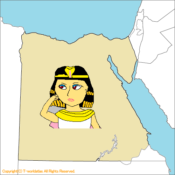
Second, multiple rulers began to claim the title of caliph. In North Africa, the Fatimid dynasty, founded by the Ismaili branch of Shia Islam, arose in opposition to Abbasid Sunni rule. Its rulers also claimed to be caliphs. One of them, al-Mu‘izz, conquered the fertile land of Egypt in the late 10th century and turned the newly founded city of Cairo into the center of a powerful empire.
On the Iberian Peninsula (roughly modern Spain and Portugal), a surviving branch of the once-overthrown Umayyads had established the Emirate of Córdoba in the 8th century and stood as a rival to the Abbasids. As Europe stabilized in the 10th century, Mediterranean trade flourished, and Córdoba grew immensely prosperous. Drawing on this prosperity, the ruler Abd al-Rahman III eventually assumed the title of caliph as well. Thus, three caliphs — in Baghdad, Cairo, and Córdoba — stood side by side, and the fragmentation and autonomy of regional powers in the Islamic world became irreversible.
Central Asia
Islam also spread among the Turkic peoples living in Central Asia at the time, giving rise to Turkic Islamic dynasties. The Kara-Khanid Khanate is considered the first of these; in 999 it overthrew the Iranian Samanid dynasty and emerged as the dominant power in Central Asia.
Byzantine Empire and the Balkans
In Eastern Europe, another ruler also dared to call himself emperor alongside the Byzantine emperor. This was the ruler of Bulgaria, then a major power in the Balkans.
Simeon I, who came to the throne in the late 9th century, repeatedly defeated Byzantium and seized much of the southern Balkans. In 913, after marching on Constantinople, the Byzantine capital, he assumed the title “Emperor of the Bulgarians and Romans.”
Politically, Byzantium and Bulgaria were often at war, but economically their ties grew closer. Trade and cultural exchange flourished, and Bulgaria saw a flowering of literature, including many translations of religious and literary works into Slavonic. However, the cost of constant warfare was heavy. After Simeon’s death in 927, Bulgaria rapidly declined.
The Byzantine Empire itself entered what is known as the Macedonian dynasty, named for the origin of its founding emperor, who came to the throne in the late 9th century. From the early 10th century, when Abbasid expansion stalled and Bulgarian power began to wane, successive emperors focused on internal consolidation. Legal texts, geographical works, and histories were compiled, and renewed attention was paid to the literature and thought of ancient Greeks — a period often called the Macedonian Renaissance. Militarily, Byzantium went on the offensive again, and in the late 10th century it reconquered territories such as Syria and Cyprus from Muslim rule.
Western Europe
In Western Europe, Viking activity continued. One group, the Normans, negotiated a settlement with the West Frankish kingdom. Their leader Rollo agreed to cease raiding in return for land in the north, where he founded the Duchy of Normandy, named after his people. Formally, Normandy remained a vassal of the West Frankish kings, but in practice it operated much like an independent state.
In the West Frankish kingdom itself, the royal line of the Franks died out at the end of the 10th century, and the crown passed to Hugh Capet. From the time of the Capetian dynasty, the kingdom is generally known as the Kingdom of France.
In East Francia, the Frankish royal line had already died out at the beginning of the 10th century. The Saxon dynasty took the throne, and this realm would later evolve into the core of Germany.
Otto I of the Saxon line secured the crown of Italy (Middle Francia) in 951. In 955 he defeated the Magyars — a nomadic people who had terrorized Europe — at the Battle of Lechfeld. In 962 he again advanced into Italy and was crowned emperor, becoming the formal successor of the Roman Empire, whose title had been ambiguous since the breakup of Charlemagne’s realm.
From then on, his domain was known as the Holy Roman Empire, covering areas corresponding to modern Germany, Austria, Switzerland, the Netherlands, the Czech lands, and northern Italy. The city of Rome itself, however, belonged to the pope, so emperors frequently tried to influence and control the papacy, setting the stage for future conflicts.
Eastern and Northern Europe
As mentioned earlier, the Magyars were a major force in Europe at this time. In central Europe, the West Slavic state of Great Moravia had formed in the area of today’s Czech Republic and Slovakia. In 906, the Magyar leader Árpád attacked and destroyed Great Moravia; its eastern parts, including present-day Slovakia, fell under Magyar control.
The West Slavic Přemyslid family rebuilt a state in western Bohemia, known as the Duchy (later Kingdom) of Bohemia. Feeling vulnerable on their own, the Bohemian rulers sought the protection of Otto I. When the Holy Roman Empire was established in 962, Bohemia became one of its constituent states.
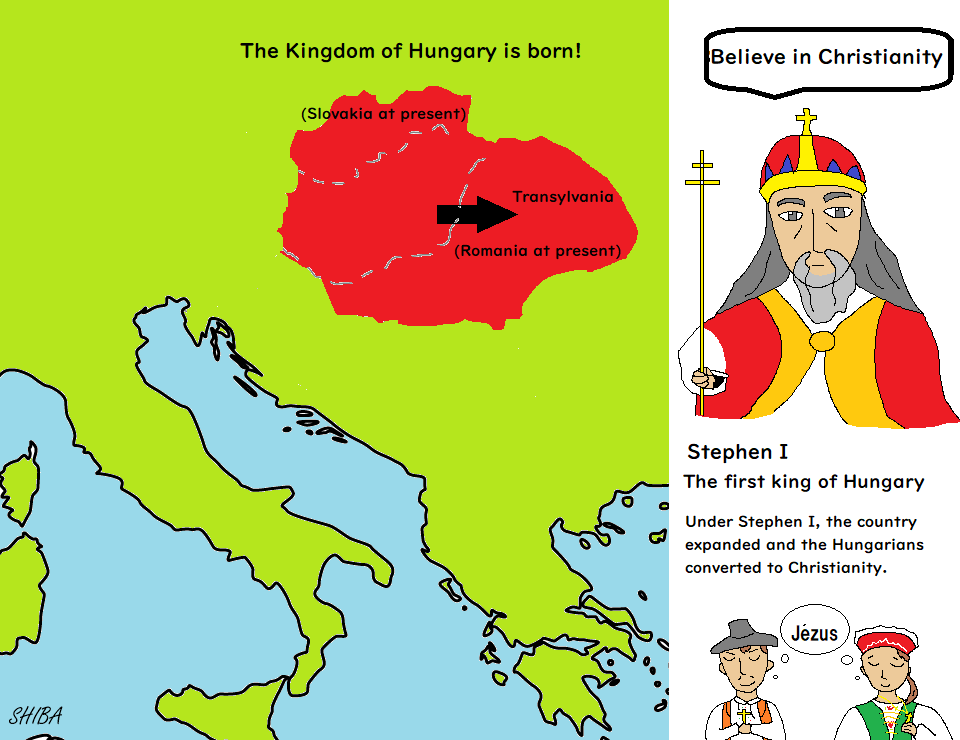
After their defeat at Lechfeld in 955, the Magyars mended relations with the Holy Roman Empire, gradually settled down, and adopted Christianity. In the year 1000, Stephen I was formally recognized as a Christian king, marking the birth of the Kingdom of Hungary.
The 10th century was an age when Christianity spread to many so-called “foreign” peoples, just as it did to the Magyars. In the lands of the West Slavs, the Piast ruler Mieszko I accepted baptism into the Catholic Church in 966, laying the foundations of the Polish state.
The same pattern can be seen among the Vikings. In Denmark, Harald “Bluetooth” Gormsson received baptism in the late 10th century. He is remembered for unifying Denmark for the first time, and his name later inspired the term “Bluetooth” used for modern digital wireless technology.
In Norway, King Haakon the Good accepted Catholic Christianity in the mid-10th century. Through Norwegian settlers, the faith also spread to Iceland, which at the time belonged to the Norwegian sphere of rule. Because Iceland lay so far from Norway, a distinctive society developed there early on, and an island-wide assembly known as the Althing, where common affairs were discussed, is thought to have begun in the 10th century.
At the end of the century, a man called Erik the Red committed crimes and was banished from Norway. Sailing westward, he discovered a new land which he named Greenland and encouraged Icelanders to settle there. In reality, however, it had far more ice than “green” compared to Iceland.
Meanwhile, the Eastern Slavic Rus — who had formed states at Novgorod and Kiev at the end of the 9th century — had strong economic ties with Byzantium. Perhaps unsurprisingly, they chose Eastern Orthodoxy rather than Catholicism. Grand Prince Vladimir I of Kiev, who came to the throne in 978, adopted Orthodoxy as the state religion at the end of the 10th century. In doing so, the Rus also joined the wider Christian world.
Events
around 906 Magyar Árpád destroys the Moravian Kingdom (Eastern Europe)
907 Fall of the Tang Dynasty (China)
909 Establishment of the Fatimid Dynasty (North Africa)
911 Norman monarch Rollo establishes the Duchy of Normandy in northern France (Western Europe)
913 Self-proclaimed Emperor Simeon I, at the height of the First Bulgarian Kingdom (Balkan Peninsula)
916 The Khitan Liao Dynasty is established in northern China (East Asia).
around 924 The Kingdom of Croatia is established (Balkan Peninsula).
926 The Bohai Dynasty is destroyed by the Khitans (East Asia).
929 Abd al-Rahman III declares himself caliph (Iberian Peninsula).
935 Tengyō no Ran(天慶の乱)~941 (Japan).
935 Wang Geon of Goryeo seizes the throne from Silla (Korean Peninsula)
936 The Khitan acquire the Sixteen Prefectures of Yanyun (East Asia)
937 The Dali Kingdom is established in the Yunnan region (East Asia)
946 The Buyid dynasty enters Baghdad and gains sovereignty from the caliph (Western Asia)
955 Battle of Lechfeld (Western Europe)
960 Zhao Kuangyin establishes the Song Dynasty (China)
962 Otto I is crowned; the Holy Roman Empire is established (Western Europe)
966 Mieszko I of Poland converts to Christianity (Eastern Europe)
966 Ding Beling establishes the Great Quete Kingdom (South East Asia)
972 Al-Azhar University is established in Cairo (North Africa)
around 982 Eric the Red arrives in Greenland (Northern Europe)
987 The Capetian Kingdom of France is established (Western Europe)
989 Vladimir I of Kievan Rus’ converts to Eastern Orthodoxy (Russia/Ukraine)
999 The Karakhanids destroy the Samanids (Central Asia)
1000 Stephen I ascends to the throne; the Kingdom of Hungary is established (Eastern Europe)
9th century ← → 11th century(Japanese)