5th century Nomadic tribes shook the world



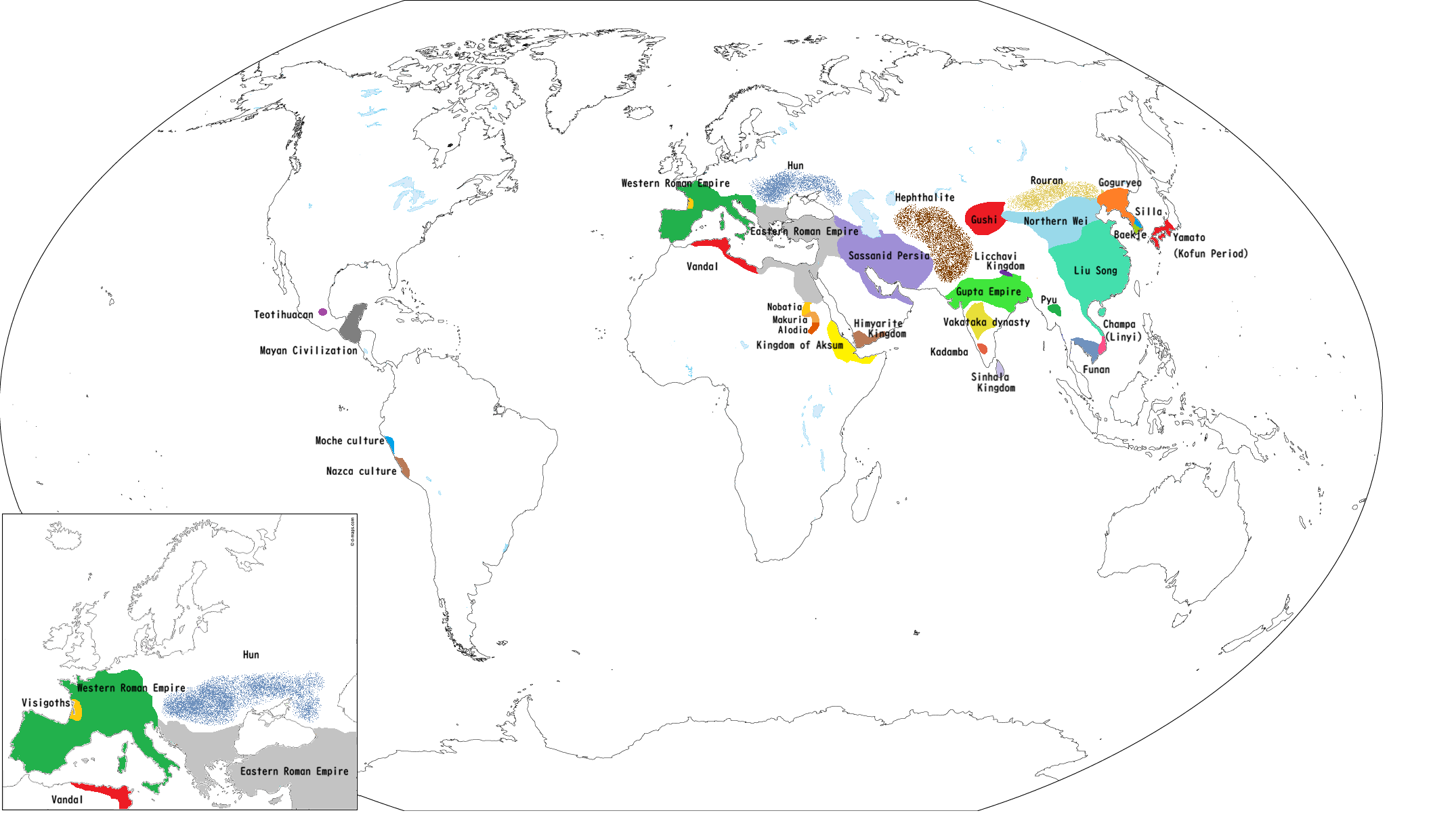
The 5th century was a time when nomads had a strong presence in various parts of Eurasia. People such as the Huns in the west, the Hephthalites in Central Asia, and the Xianbei(鮮卑) in the east were often treated as ‘‘savages’’ by farmers society.
Armed with horses, they began to challenge the dynasties that prospered through agriculture. And pushed out by the advance of these new forces, other ethnic groups also began to migrate… bringing about major changes that heralded a new era.
East Asia
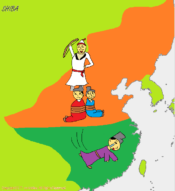
In the Northern dynasty of China, the time of “Sixteen kingdoms” came to an end, as Emperor Taiwu(太武帝) of the Northern Wei(北魏) unified the region.
The Tuoba(拓跋) clan, which founded the Northern Wei dynasty, was originally a branch of the Xianbei(鮮卑) nomadic people, but as they came into contact with Chinese culture they dismounted from their horses and adopted a sedentary lifestyle.
For this reason, Emperor Taiwu employed many Han Chinese officials, including Kou Qianzhi(寇謙之), who helped bring Daoism to completion.
And Emperor Xiaowen(孝文帝), who ascended the throne in 471, went even further by promoting a Sinicization policy—adopting Han Chinese language, customs, and clothing—in effect assimilating with the Han population. In terms of land, the equal-field system(均田制) and the Three Elders system(三長制) were adopted: land was allocated according to household registers, from which taxes were collected.
On the Mongolian plains, as the Xianbei moved south, they were replaced by a new nomadic state called Rouran(柔然).
As northern China was occupied by “foreign peoples”, the center of Chinese culture shifted to the south. Five dynasties rose and fell in southern China, from the Eastern Jin (東晋) in the 4th century to the Chen (陳) in the 6th century, but excellent Chinese culture flourished in each era. Added Wu(呉)of the Three Kingdoms period to them, their culture was called the “Six Dynasties Culture”. Famous cultural figures who were active in the 5th century include the poets Tao Yuanming(陶淵明).
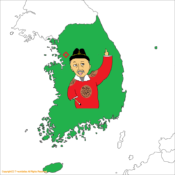
On the Korean Peninsula, the conflict between Baekje and Goguryeo finally began in earnest. King Gwanggaeto, who greatly expanded the territory of Goguryeo. King Jangsu, who succeeded him in 413, erected the Gwanggaeto Monument to honor the previous king’s achievements. It was also during his time that the royal capital of Goguryeo was moved to Pyongyang.
In 475, the Goguryeo army led by King Jangsu conquered Baekje’s capital, Hanseong (present-day Seoul), inflicting a major blow on Baekje, killing King Gae-yeon, who ruled Baekje at the time, in battle. As a result, Baekje moved its capital to Ungjin in the south and attempted to make a comeback. It is said that the King of Longevity lived a full life in 491 at the age of 97. The name Longevity King was given to him after his death, but he really lived a long life…
At this time, Japan was still far from being unified, and the so-called “Five Kings of Wa” sent messengers to China one after another.
South Asia,West Asia
In India, the Gupta dynasty reached its peak under Chandragupta II. During his reign, a new style of Buddhist art flourished, adorning religious sites across India such as the Ajanta Caves. It was also around this time that Hinduism expanded greatly, and both Hinduism and Buddhism were transmitted to Southeast Asia, where new states were emerging.
However, in the latter half of the fifth century after Chandragupta’s death, the nomadic Hephthalites (White Huns) invaded India, cutting off trade routes and ushering in the Gupta dynasty’s decline. The Hephthalites even influenced the succession to the throne of the Sasanian Persian Empire in West Asia, leaving a major mark on subsequent history, but few sources from the time survive and their true nature remains shrouded in mystery.
Europe
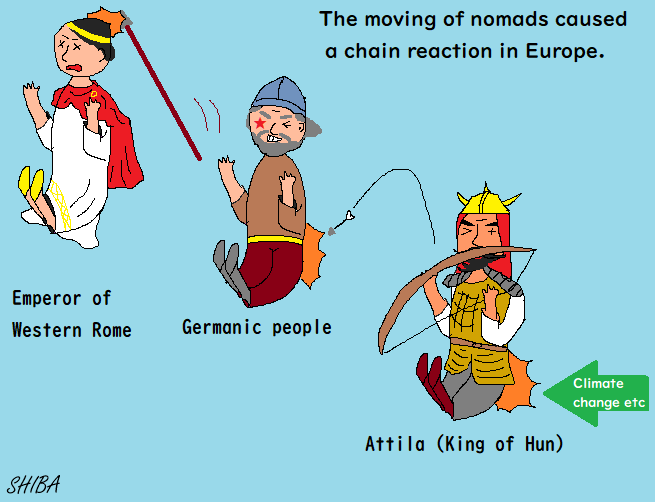
A similarly mysterious tribe was the nomadic Huns who expanded into Europe. The name of Attila the Great was well known as who terrorized Europeans at the time.
From the late fourth century through the fifth century, as the Huns ravaged Europe, the Germanic peoples living there were forced to migrate, leading to the establishment of kingdoms by groups such as the Goths, Franks, Vandals, and Burgundians in various regions; some of these even repeatedly invaded the Western Roman Empire, subjecting the city of Rome itself to destruction and plunder.
In 476, the emperor of the Western Roman Empire, who had been weakened by a series of developments, was forced to abdicate due to an attack by the Germanic military man Odoacer. The Western Roman Empire collapsed less than 100 years after its division.In his place, Clovis, a Frankish tribe who ruled Western Europe, rose to prominence.
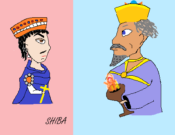
In contrast, in the capital of the Eastern Roman Empire, Constantinople, the massive walls built under Theodosius II kept foreign peoples from breaking in. In the latter half of the fifth century, Emperor Anastasius I improved the efficiency of the tax system and thereby stabilized the state’s finances. Thanks also to its control over prosperous regions such as Egypt and Syria, the Eastern Roman Empire was able to survive.
One theory is that the Huns were descendants of the Xiongnu(匈奴) who once threatened China. If this is true, they would have rushed through the steppes of inland Eurasia and made their way all the way to Europe. This is an event that makes us realize that Eastern history and Western history are connected in many ways.
Event
402 Sheluen(社崙), the ruler of Rouran(柔然) ascended the throne and rose to the Mongolian plateau (East Asia)
409 Vandals, Suevis, and Alans invade the Iberian Peninsula (Spain)
413 San (讃, one of the five kings of Wa). sent a messenger to Eastern Jin (Japan and China)
414 Chandragupta II died (India)
420 Song(宋)dynasty established in the Southern dynasty ~ 479 (China)
426 Kinich Yax Kuk Mo ascended to the throne as King of Copan (Maya Civilization, Central America)
427 King Jangsu of Goguryeo moved the capital to Pyongyang (Korea)
429 Gaiseric established the Vandal Kingdom (North Africa)
431 Council of Ephesus Among the Christian sects, Nestorianism wass considered heretical (Europe)
439 Emperor Taiwu(太武帝) of Northern Wei(北魏)unified the era of the Sixteen Kingdoms (China)
443 Establishment of the Burgundian Kingdom (Europe)
Around 450 The nomadic Hephthalite invaded the Gupta dynasty (India)
451 Attila of Huns overran the Western Roman Empire and are defeated at the Battle of Catalaunum (Europe)
451 Council of Chalcedon Among the various Christian sects, the Monophysite school was considered heretical (Europe)
471 Emperor Xiaowen(孝文帝) ascended the throne in Northern Wei. Absorbing Chinese culture and implementing assimilation policy ~ 499 (China)
475 King Jongju captured Hanseong in Baekje (Korea)
473 Kassapa I ascended the throne ~495. Construction of Sigiriya Royal Palace (Sri Lanka)
476 Odoacer destroyed the Western Roman Empire (Europe)
481 Clovis founded the Frankish kingdom (Western Europe)
493 Theodoric established the Ostrogothic kingdom in Italy.
5th century (date unknown)
St. Patrick begins Christian missionary work in Ireland.
Christianity spread to Sudanese countries. (Africa)
Bantu people expanded into southern Africa.
Northern Europe entered a period of ethnic migration.