9th century The Glory of Pirates and the Spread of Islam



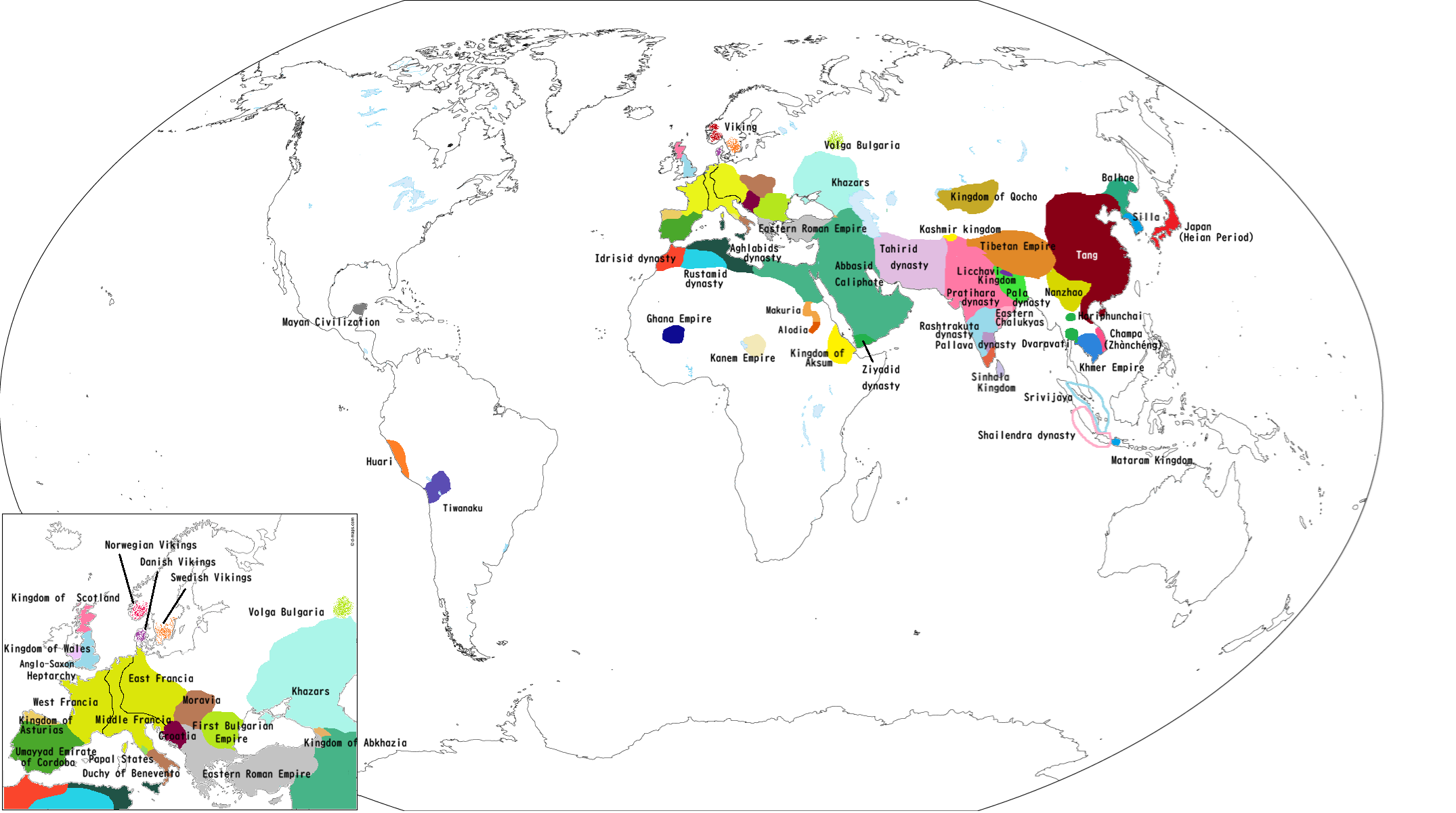
When the 9th century began, Viking activity in Northern Europe entered its full phase. In the Middle East, under the Abbasid Caliphate, movements seeking independence from the central government in Baghdad emerged, while Islam continued to spread to distant lands.
Western Europe
Charlemagne, who had earned the great title of “Emperor and successor of Rome,” died in 814. His son, Louis the Pious, followed in 840. Afterward, Charlemagne’s three grandsons divided the Frankish Empire into three parts — West Francia, Middle Francia, and East Francia — under the Treaty of Verdun in 843. This division reflected the Frankish custom of dividing inheritances equally among sons.
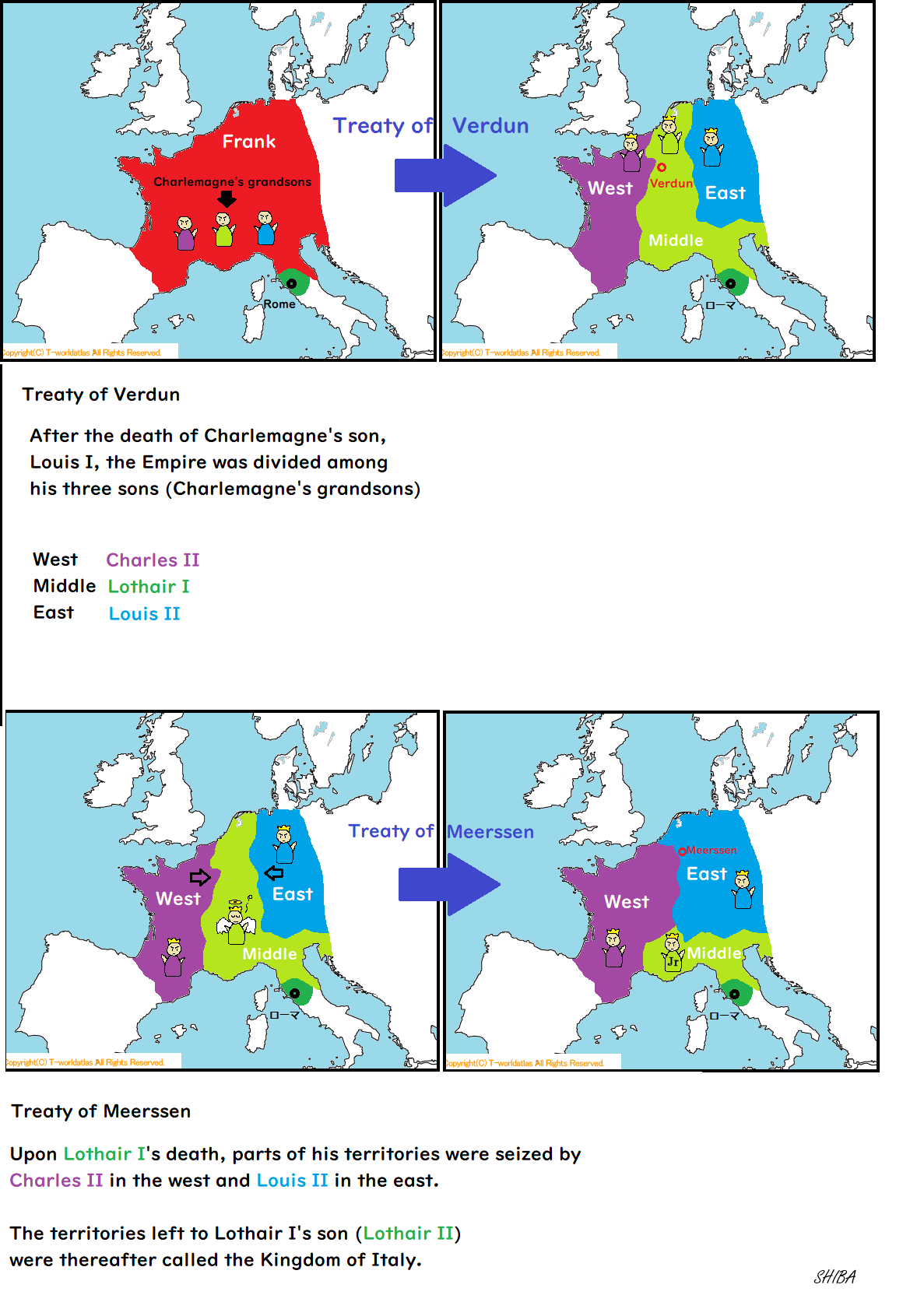
The three kingdoms were reorganized again in 870 under the Treaty of Meerssen, where parts of Middle Francia (Italy) were incorporated into West and East Francia. All three would later grow into major powers of Western Europe.
Northern and Eastern Europe
Around the same time, Europe was shaken by the arrival of the Vikings from the north. The Vikings were non-Christian seafarers who skillfully navigated small ships and carried out raids. Major cities such as London and Paris, as well as wealthy churches adorned with precious metals, often fell victim to their attacks.
To the people of Western Europe, the Vikings were known and feared as “Norsemen” or “Danes.” Yet, in time, they embraced Christianity and formed the kingdoms of Norway, Denmark, and Sweden.

The Vikings, however, were not only raiders but also traders. By the mid-9th century, a commercial route had taken shape, linking Scandinavia through the Eastern Slavic territories to the Black Sea. This development spurred changes in Eastern Slavic society. According to tradition, around 862 a man named Rurik came to rule the Slavs and founded the Kingdom of Novgorod. His followers were called “Rus,” though some scholars argue that the term originally referred not to the Slavs but to the Viking group itself.
Eventually, the Rus established states beyond Novgorod as well. Around 882, they conquered Kiev/Kyiv (now the capital of Ukraine), which would become the heart of the Rus realm.
In the Balkan Peninsula of Eastern Europe, the South Slavs had settled and gradually accepted Christianity. The region lay on the frontier between the Roman Catholic and Byzantine churches. As a result, the Croats in the west embraced Roman Catholicism, while in the east, King Boris I of Bulgaria accepted Eastern Orthodoxy and entered the Byzantine sphere. Thus, the religious map of the Balkans became increasingly complex.
Britain
On Britain’s island, the seven Anglo-Saxon kingdoms were moving toward unification, completed in 829 by Egbert of Wessex. From that time on, the country came to be known as “England,” meaning “Angles’ land” .
Around the same period, England suffered repeated attacks from the Vikings, particularly the Danes. In 887, King Alfred the Great of Wessex defeated the Danes, concluding peace by allowing them to settle in the southeastern region of the island — later known as the Danelaw.
In the north of the island stood two Celtic realms: Dalriada of the Scots and Alba of the Picts. Both also suffered from Viking invasions. To resist them, the two kingdoms drew closer, and in 843, Kenneth Mac Alpin — of mixed Scottish and Pictish lineage — united them as King of Alba, laying the foundations of what would become Scotland.
Middle East and Africa
By the end of the 8th century, the Abbasid Caliphate’s conquests had largely subsided, ushering in a period referred to as Pax Islamica — “the Peace of Islam.”
The next challenge was how to govern such an extensive territory. The Abbasids developed a bureaucratic system utilizing government officials — and among them, Persians, who possessed deep experience and administrative knowledge from their former empires, proved indispensable.
After the fall of the Sasanian Empire, Persians had lived under Umayyad rule, but under the Abbasids, they gained opportunities to serve as bureaucrats and scholars, with some rising to the rank of vizier.
As peace prevailed, cultural and scientific endeavors flourished. Caliph al-Ma’mun, who ascended the throne in 813, founded the Bayt al-Hikmah or “House of Wisdom” in Baghdad, where the study of classical Greek philosophy and science was promoted. One of its most prominent scholars was the Persian mathematician and astronomer al-Khwarizmi, who continued his research there.

Nonetheless, maintaining peace required military strength. For this, the Abbasids recruited Turkish nomads from Central Asia as soldiers. Skilled horsemen, they served as military slaves (mamluks), though their role was closer to that of professional mercenaries rather than chattel slaves.
As Persians and Turks expanded their spheres of activity, the Arab caliphs gradually became nominal rulers. Consequently, regional dynasties such as the Tulunids in Egypt, the Tahirids in Iran, and the Samanids in Central Asia gained autonomy and eventually broke away from Baghdad’s control.
Islam also spread through trade. Caravans using camels crossed the Sahara Desert, establishing flourishing commerce with Africa. As a result, African kingdoms such as the Ghana Empire (near present-day Mali) and the Kanem Kingdom (around Lake Chad) prospered through the trade of gold and rock salt — and in time, these African states adopted Islam as well.
Meanwhile, the Christian Kingdom of Aksum in Ethiopia, surrounded by Islamic powers, gradually declined in influence.
India and Southeast Asia
After the decline of the Vardhana dynasty in the late 7th century, India remained politically fragmented. In the 9th century, three main powers competed for dominance: the Pratihara in the north, the Pala in eastern Bengal, and the Rashtrakuta of the Deccan Plateau in the south.
During this era, Buddhism in India waned while Hinduism became the dominant faith. The Pala dynasty is considered the last major Indian dynasty to uphold Buddhism.
In Southeast Asia, Jayavarman II ascended the throne in 802 in present-day Cambodia and established a new capital at Angkor. The Angkor Kingdom unified the Chenla territories and rose as a major power influencing not only Cambodia but much of southern Indochina. The Angkor rulers, too, were devoted to Hinduism (though Angkor Wat would not be built until later).
On the island of Java in Indonesia, the Shailendra dynasty reached its zenith, briefly extending influence across the Strait of Malacca and into the southern Indochinese region. It was during this time that the monumental Buddhist temple Borobudur was constructed — a symbol of their prosperity and one of Southeast Asia’s greatest religious sites.
However, by the late 9th century, internal conflict led to the expulsion of the Shailendra family from Java, and the old Sanjaya dynasty’s Mataram Kingdom was restored, paving the way for the unification of the island.

East Asia
In the Mongolian Plateau, the Uyghur Khaganate — a nomadic state that had helped suppress the An Lushan Rebellion in the 8th century — collapsed in 840 after conflict with the Kyrgyz. For a time thereafter, no powerful nomadic state dominated the steppe.
In Japan, this period corresponds to the early Heian(平安) era. In 801, Emperor Kanmu (桓武天皇)appointed Sakanoue no Tamuramaro(坂上田村麻呂) as Sei-i Taishōgun (征夷大将軍:Great General for the Subjugation of the Barbarians) and launched campaigns into the northeast, subduing the Emishi leader Aterui(阿弖流為) and bringing the region under Yamato control.
Emperor Kanmu also sought to reform Buddhism, which had grown corrupt during the Nara period. Responding to this call, monks Saichō(最澄) and Kūkai(空海) traveled to Tang(唐) China to study the faith.
At that time, however, the Tang dynasty was in decline, plagued by aristocratic infighting and weakened imperial authority. On the Korean Peninsula, Silla(신라/新羅) too was destabilized by internal power struggles — leading to episodes such as the semi-independent rule of maritime leader Chang Bo-go(장보고/張保皐).
In 873, a severe drought struck China, resulting in famine and social unrest. Salt smugglers Wang Xianzhi(王仙芝) and Huang Chao(黃巢) led large-scale peasant uprisings (the Huang Chao Rebellion), pushing the Tang Empire toward its eventual collapse.
As Tang China weakened, Japan’s missions to the Tang court (Kentōshi:遣唐使) became less frequent, and by the late 9th century, they were abolished on the advice of Sugawara no Michizane(菅原道真). Having already absorbed much from China, Japan began to develop its own distinctive culture — known as kokufū bunka(国風文化), or “native style culture.”
America
During this period, the Maya civilization in the Yucatán Peninsula underwent great upheaval. Southern cities such as Tikal and Copán rapidly declined. The most widely accepted theory attributes this to overpopulation and drought, which disrupted the traditional city networks. Consequently, the Maya’s cultural and political focus shifted northward to cities like Chichén Itzá.
Events
804 The Avars collapse after being defeated by the Franks (Central Europe)
804 Saicho and Kukai travel to Tang China (Japan and China)
814 Death of Charlemagne (Western Europe)
around 820 Borobudur completed (Java)
828 Jang Bogo(張保皐/장보고) was appointed as Ambassador of Cheonghaejin; gradually gained independent from Silla (Korean Peninsula)
829 Egbert Unifies the Others (Britain)
840 The collapse of the Uighurs. The unity of the Mongolian Plateau is lost (Mongolia)
843 Treaty of Verdun The Frankish Empire splits into three kingdoms (Western Europe)
Around 862 Establishment of the Novgorod State (Russia)
864 Boris I accepts Christianity (Bulgaria)
866 Otenmon Incident (Japan)
868 The Tulunid dynasty is established. It becomes independent from the Abbasid dynasty (Egypt)
Late 9th century Brothers Cyril and Methodius spread Christianity to the Slavs (Eastern Europe)
870 Treaty of Mersen: Reorganization of the former Frankish Empire (Western Europe)
875 The Samanid dynasty is established and becomes independent from the Abbasid dynasty (Iran and Central Asia)
875 Huang Chao Rebellion ~884(China)
886 King Alfred the Great recaptures London from the Danes (England)
894 The Japanese missions to Tang China are suspended at the suggestion of Sugawara no Michizane (Japan)
895 Magyar invasion of the Hungarian Plain (Eastern Europe)