Why was the wall built in Berlin?

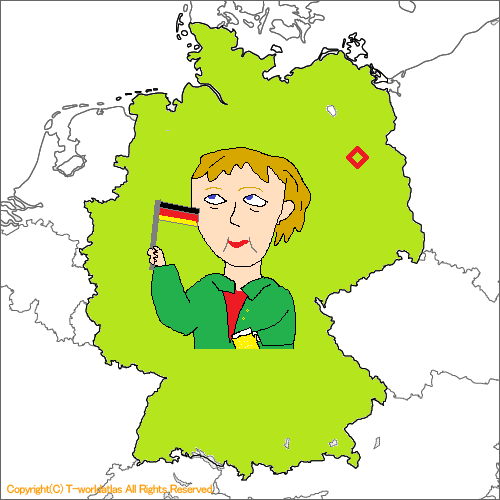

If you ask what do you image about “Berlin”? to people from a certain generation up, more than half of them will probably answer “Berlin Wall.” When the Berlin Wall was torn down was in 1989, was also a turning point in Japan’s history as the Showa era changed to the Heisei era.
Germany now plays the core of the EU and has a great influence on European movements. Why was the capital of this nation surrounded by a wall? To put it very simply, it was because Berlin is “in eastern Germany.”
The disjointed Holy Roman Empire
Germany’s history is complex and difficult to understand, but the important points can be summarized as follows. In 962, a kingdom called the Holy Roman Empire was established. The reason why Germany is called “Rome” is because it had the meaning of being the official successor to the Western Roman Empire, which fell in the 5th century.
The top of this kingdom was the “Holy Roman Emperor”, but despite his exaggerated name, his authority was never great. Germany was covered in deep forests such as the “Schwarzwald (Black Forest)”, and the transportation network was not well developed at the time, making it difficult for the emperor to rule the vast German lands by himself. As a result, most of the empire was left to local aristocrats to govern.
From around the 11th century, the emperor began to fight with the Pope about “who was the top Catholic”. And the Emperor began to focus more and more on Italy and less on Germany.
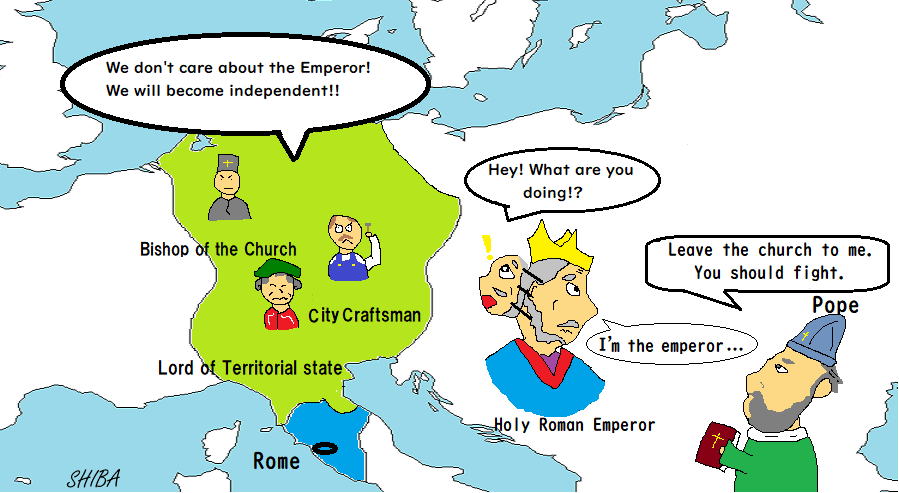
As a result, in Germany (Holy Roman Empire), local nobles and bishops became rulers of each land and made their own laws rather than the emperor. This was called “Territorial state”. In other words, it was a situation in which smaller independent countries were crowded together within the Holy Roman Empire.
Brandenburg and Prussia
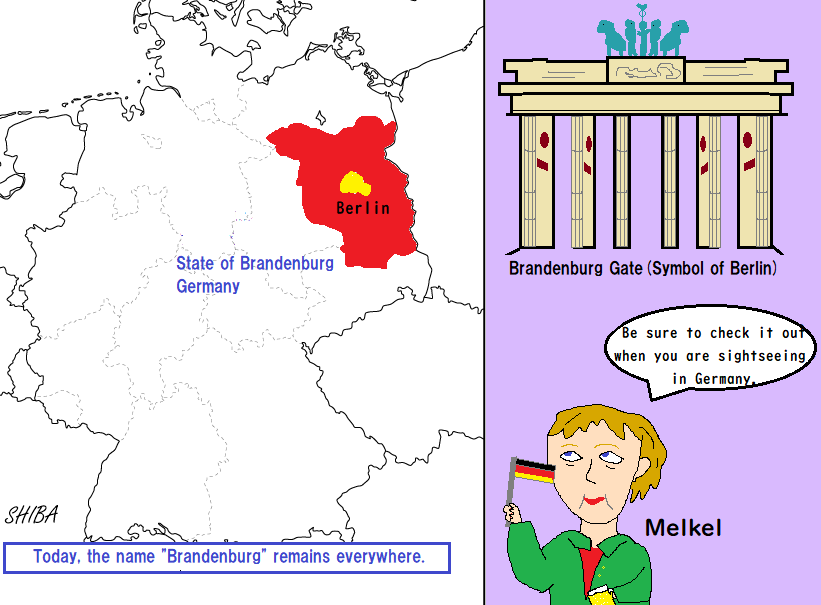
Berlin was the central city of the “Margrave of Brandenburg”. As the name “margrave” suggests, this place was located on the “eastern edge” of the Holy Roman Empire and was initially a frontline location in the war against infidels.
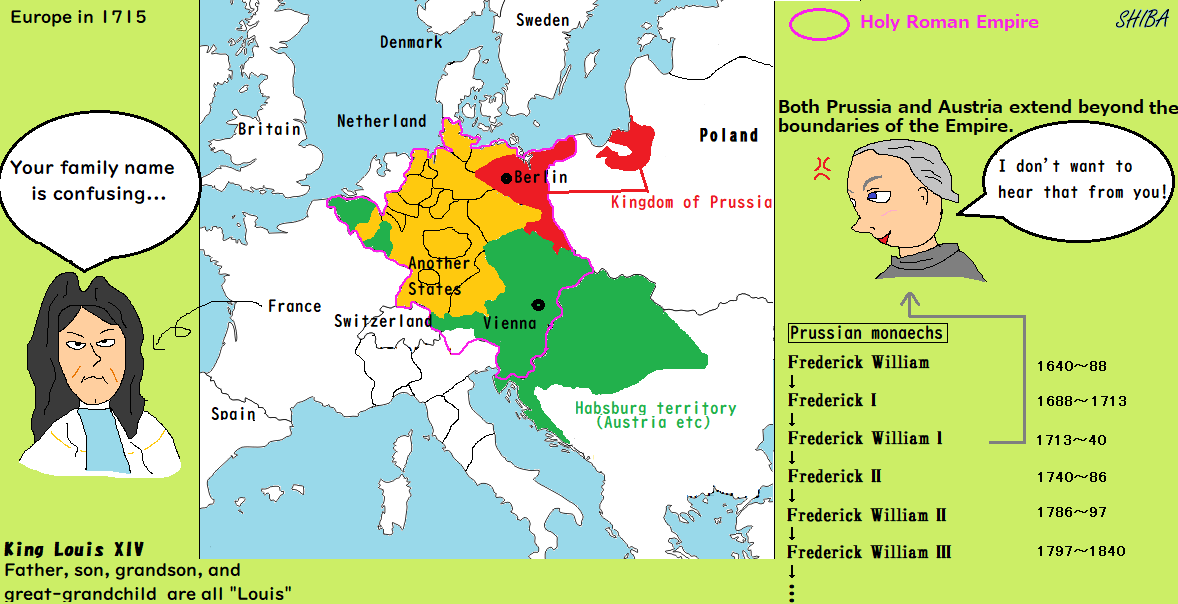
On the other hand, Germans expanded into the Baltic Sea, a thriving area of commerce, and built cities in the present-day Baltic States and northern Poland. One of them is the Prussian region on the Baltic Sea coast. This area was once under Polish control, but in the 17th century, a certain monarch came to rule it. This was the Duke of Brandenburg. And from then on Brandenburg came to be called the “Duchy of Prussia”, and from 1701 the “Kingdom of Prussia”.
The Kingdom of Prussia strengthened its military power during the 18th century under Frederick William I and Frederick II, and grew to become a country that was respected by major powers such as France and Russia.
United Germany
In the 19th century, Napoleon appeared in France and invaded Germany, and the Holy Roman Empire disappeared in both name and reality. Although the Germans were large in number as an ethnic group, if they were divided into small countries (Territorial states), they would not be able to win even if they fight against France. Those who thought so would proceed with the unification of Germany. The Kingdom of Prussia was the leader.
Prussia annexed Territorial states under the powerful policies of Bismarck, known as the Iron Chancellor. In 1866, Prussia expelled Austria, which was also a large German power, and took the initiative, finally completing unification in 1871. The name was changed to “German Empire”. In addition, Berlin, the capital of Prussia, became the capital of the German Empire.
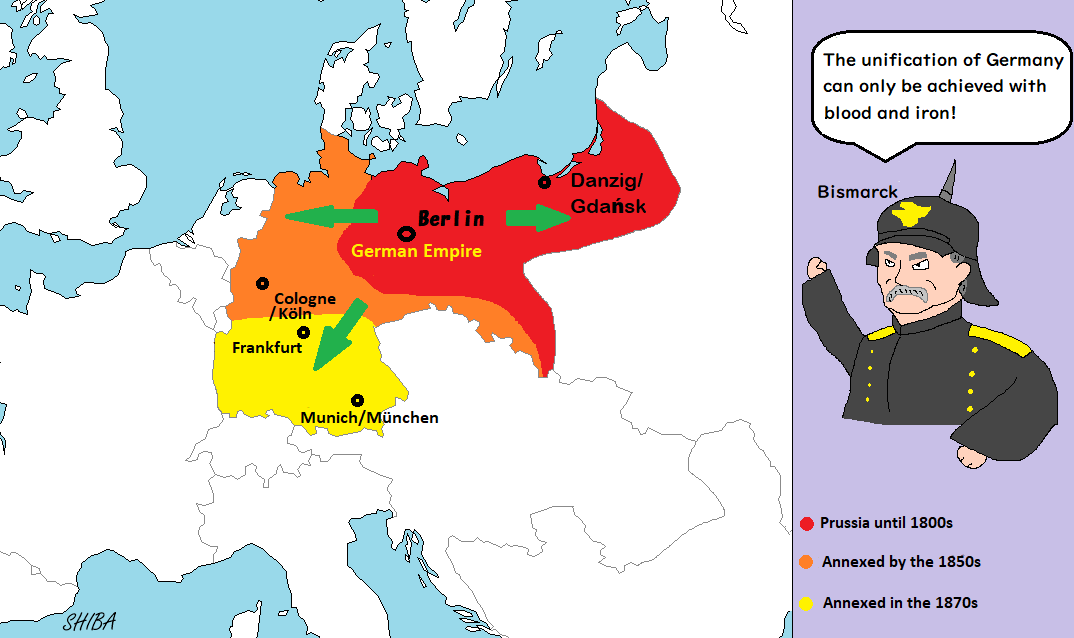
Prussia, which was already a military power, annexed its surroundings and was reborn as the even more powerful German Empire. This frightened the advanced European nations such as France and Britain.
While both nations dominated the world through the industrial revolution, Germany has achieved development that demands it catch up and surpass them. Britain and France tried to suppress Germany, resulting in World War I. After suffering huge casualties, Germany was defeated. Just before the end of the war, Germany changed from an empire to a republic, and not only was its territory reduced, but it was also forced to pay astronomical reparations. Naturally, Germans were outraged.
Despite this, they somehow managed to return to the international community and rebuild Germany that had been devastated by the war. But just then the Great Depression of 1929 occurred, and society was hit hard again. The German people turned to Hitler, who had “strong convictions” and “power of action,” to end their difficult times as soon as possible.
Tragedy of World War II and Occupation
Hitler pulled out of the Depression with his devilish leadership and set out to take revenge on World War I. However, as a result of this, World War II broke out in 1939, resulting in more casualties than in the ” W W I ” due to battles and the Holocaust.

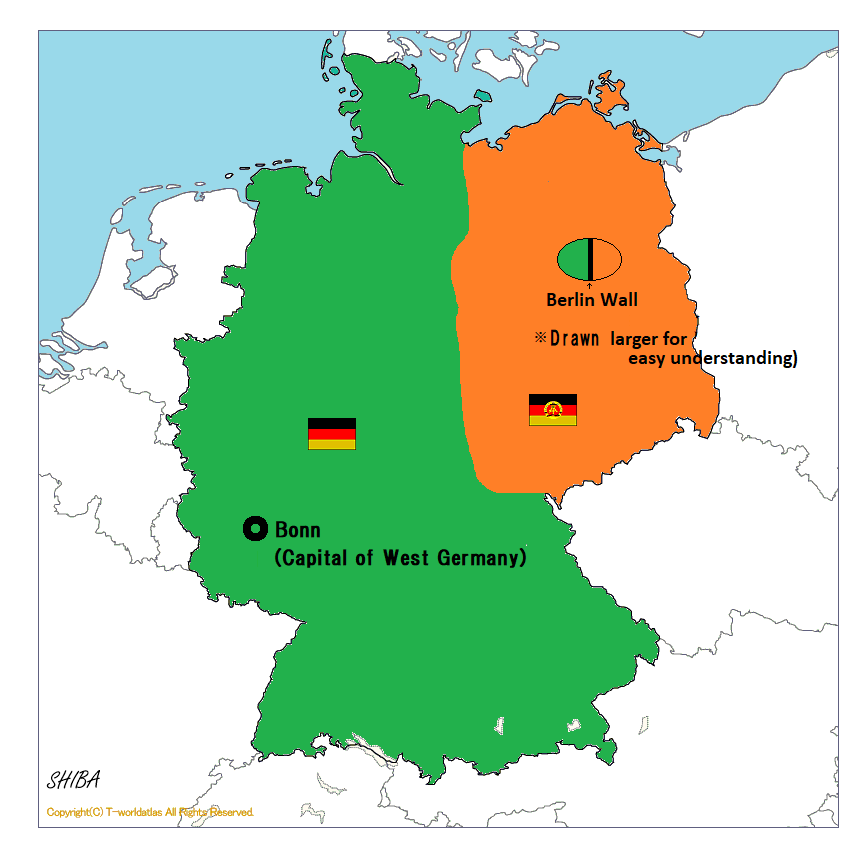
Germany was defeated again in World War II. The United States, Britain, Soviet Union and France became the “victory nations,” and Germany was occupied and divided by these four. Berlin was also divided into four parts at this time.
In order to prevent a dangerous person like Hitler from becoming leader, a new German government was created by people close to the victorious nation, but at this time, there was a difficult question, “What kind of government would be ideal?” Opinions began to diverge between the capitalist nations, United States, Britain, France, and the socialist nation, Soviet Union. As a result, the capitalist state of “West Germany” and the socialist state of “East Germany” were born.
Construction of wall
While the territory based on the occupied territories of the United States, Britain, and France became West Germany, the territory occupied by the Soviet Union became East Germany. And there was a problem about the capital, Berlin. The Brandenburg region, which includes this city, became East Germany, but Berlin was divided and ruled by four nations, so even after the establishment of East and West Germany, the area that was occupied by the United States, Britain, and France (West Berlin) also became West Germany. In other words, West Berlin became an enclave of West Germany (blue and green areas on the map).
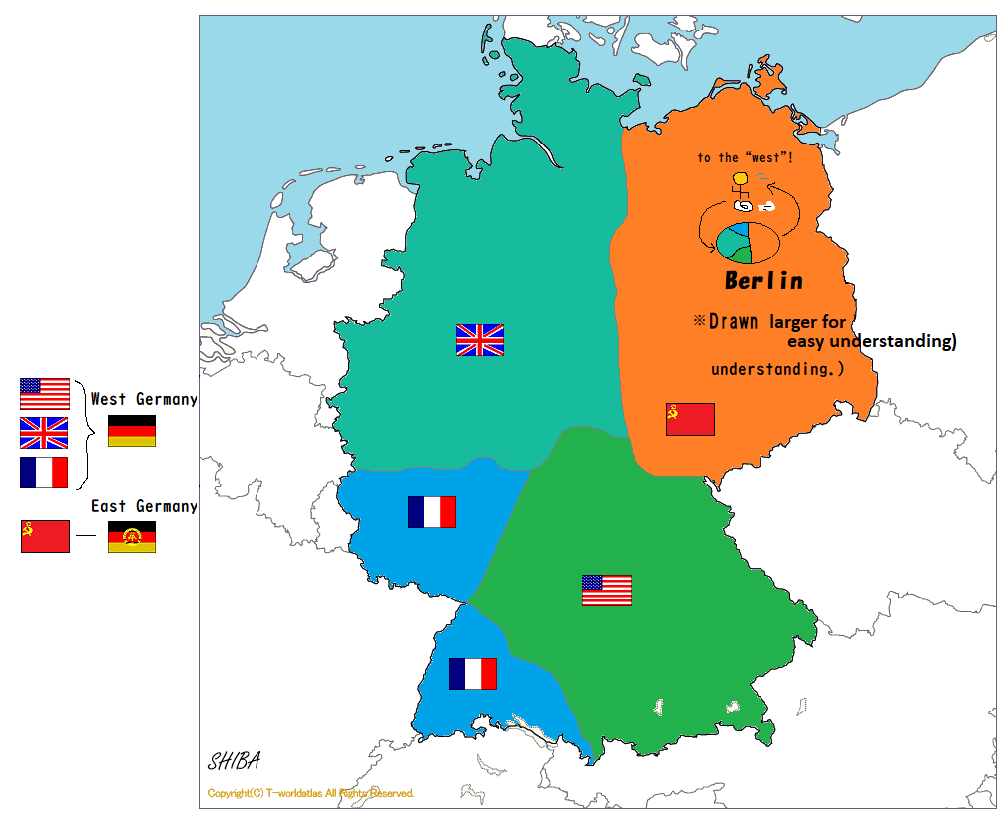
Eventually, people’s freedoms in East Germany began to be suppressed through censorship and surveillance, and people began to flee to West Germany. Especially since West Berlin was the closest West Germany, the number of defectors to this city continued to increase.
In 1961, the East German government erected barbed wire between East and West Berlin, making it impossible for people to move. This “wall” eventually became a “real wall” with bricks, and watchtowers were installed to arrest and kill defectors.
The Berlin Wall was seen as a “defensive wall” in the East, but in the West it was criticized as a ” Schandmauer /wall of shame” that robbed people of their freedom. This wall became a symbol of the Cold War, a conflict between the United States and the Soviet Union.
German reunification!
In the 1980s, the societies of the Soviet Union and East Germany reached their limits. In 1989, when the border between Austria (west) and Hungary (east) was opened, defectors began to flee to the west via this border.
It became clear that there was no point in having a wall between East and West Berlin, and the wall was finally torn down by Berliners. During this time, government negotiations progressed, and Germany was unified in 1990.
This is an event that teaches us that building walls is powerless in the face of people’s strong will. It can also be said to be a history lesson that the presidents and prime ministers of “certain nations” who have recently built walls between themselves and neighboring countries should be aware of.