6th century The Great Empire Returns


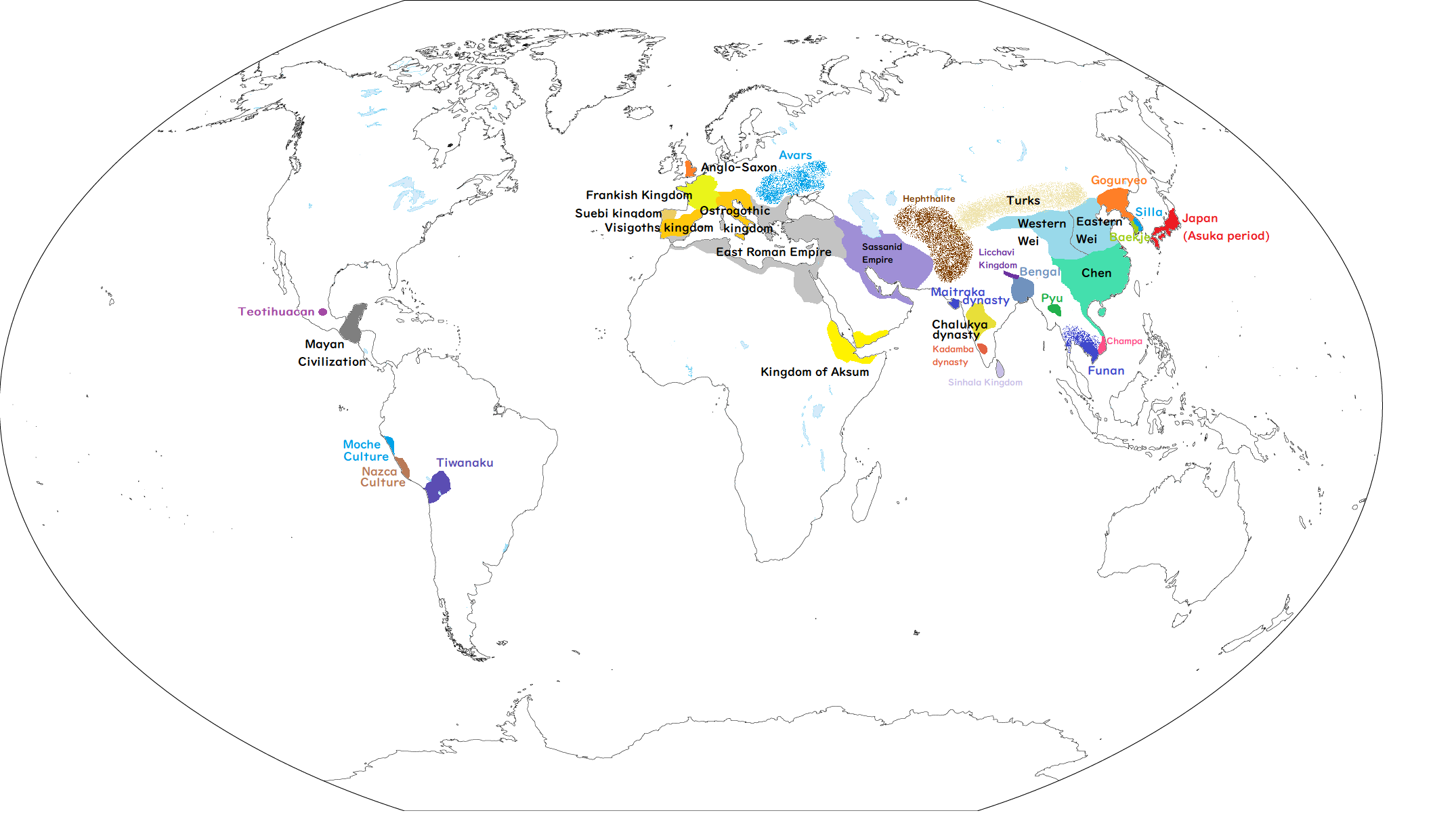
6世紀の世界を一言で言うのは難しいのですが、衰退の色を見せていた西アジアの帝国が復活した点、中国の分裂時代がようやく終わりを告げた点、他方ヨーロッパではまだまだ混迷が続いていた点などが挙げられます。
もくじ
East Asia
China
The end of the long-lasting Southern and Northern Dynasties period in China was approaching. The Northern Wei(北魏) of the Northern Dynasties was originally founded by the Xianbei(鮮卑), a nomadic people from the north. Emperor Xiaowen(孝文帝), who ruled this dynasty until the end of the 5th century, actively embraced Han Chinese culture.
However, this resulted in Han Chinese being favored as officials, while many nomads were treated poorly. Dissatisfied people sparked the Six Garrisons Revolt (六镇之乱) in 523, leading to the split of Northern Wei in 534 into Western Wei (西魏) and Eastern Wei (東魏).
These two dynasties were subsequently usurped by different clans, forming the Northern Qi (北斉) and Northern Zhou (北周). In 577, Northern Zhou defeated Northern Qi to unify the north, but failed to establish a stable regime like Northern Wei.
In the Southern Dynasties, the first half was ruled by Liang (梁)and the latter half by Chen(陳). Emperor Wu of Liang (梁武帝/萧衍)was the longest-reigning emperor in the Southern Dynasties (502-549) and represented a peak of the era. His son, Crown Prince Zhaoming (昭明太子/萧统), compiled the “Wen Xuan(文選),” an anthology of notable literature from the Southern and Northern Dynasties period.
During this time, Buddhism, which had declined in India, flourished in China. Bodhidharma (菩提达摩), came from India to the Liang Dynasty and introduced Zen Buddhism (禅宗).
However, after Emperor Wu’s abdication, Liang lost power, and the subsequent Chen Dynasty was a weak state. In 581, Yang Jian (杨坚) ,Emperor Wen(文帝), usurped the throne from Northern Zhou of the Northern Dynasties and built Sui(隋). In 589, he defeated Chen, unifying China for the first time in 265 years since Western Jin(西晋).
Emperor Wen established his capital in a corner of Chang’an(长安), (Daxing City/大興城) and implemented a centralized bureaucratic system by dispatching officials from the central government. To curb the power of aristocrats, he introduced the imperial examination system, or “keju(科举)/ imperial examination,” for recruiting officials. Although the keju system in Sui was still limited, its importance grew over time.
Korea
On the Korean Peninsula, the three kingdoms of Goguryeo(高句麗/고구려), Baekje(百済/백제), and Silla(新羅/신라) emerged, each growing in national power.
After Baekje lost its capital Hanseong (漢城/한성:present-day Seoul) to Goguryeo in the late 5th century, it was rebuilt under King Muryeong(武寧/무령), who ascended to the throne in 502 in the new capital of Ungjin(熊津/웅진). King Muryeong consolidated power by having members of his family govern local regions, thus unifying the country and centralizing authority. He also strengthened relations with Japan, an ally, to counter Goguryeo.
King Seong(聖/성), who succeeded King Muryeong in 523, moved the capital to Sabi (사비:present-day Buyeo) in 538 to prepare for battles against Goguryeo. It is also said that Buddhism, which had already spread in Baekje, was introduced to Japan around 538 .
Silla, which later became the dominant power on the Korean Peninsula, was born in 503 when its name was changed from Saro(斯盧/사로). King Beopheung(法興/법흥), who ascended to the throne in 514, concentrated power in himself and strengthened the kingdom. The Hwarang(花郎/화랑), an elite group of warriors, is believed to have originated during his reign. In terms of foreign relations, he prioritized ties with the Southern Dynasties of China (the Liang Dynasty at the time). In 527, he accepted Buddhism, which had been transmitted via China, and built many temples in the capital city of Gyeongju(慶州/경주).
King Jinheung(眞興/진흥), who ascended to the throne in 540, allied with King Seong of Baekje to fight their common enemy, Goguryeo. In 551, they recaptured Hansan, the former capital of Baekje, but soon after, Silla seized this city for itself. Furthermore, Silla expanded into the southern Gaya(加耶/가야) confederacy, annexing it by 562.
Japan
In Japan during this period, the Yamato Kingship was advancing the unification of the country by defeating powerful factions, such as Iwai,(磐井) who held significant influence in Kyushu(九州: the island in the southwest of Japan). At the same time, they welcomed many immigrants from continental states. As previously mentioned, around 538, Buddhism was introduced to Japan from Baekje, a kingdom on the Korean Peninsula with particularly friendly ties to Japan. However, Japan already had an indigenous religion called Shinto(神道), and the acceptance of Buddhism caused divisions of opinion within the imperial court.
As a result, this became intertwined with the power struggle within the imperial court between the influential clans—the pro-Buddhism Soga(蘇我) clan and the anti-Buddhism Mononobe(物部) clan—leading to unrest. The conflict ended with the Soga clan’s victory, and their leader, Soga no Umako(蘇我馬子), wielded significant authority, even going so far as to assassinate the opposing Ōkimi (大王:emperor). In 593, Empress Suiko(推古天皇) ascended to the throne, becoming the first Empress in Japanese history. To support her reign, Prince Umayado(厩戸皇子), also known as Prince Shōtoku(聖徳太子), was appointed regent. Prince Shōtoku collaborated with Soga no Umako, sometimes working together and at other times clashing, to uphold the Yamato Kingship.

Mongolia,Central Asia
The nomadic Rouran(柔然), who controlled the Mongolian Plateau, began to decline around the 6th century and were replaced by another nomadic group. This group was recorded in Chinese documents as “Turks”(突厥) or “Tiele”(鉄勒), which is believed to be the origin of the word “Turkey”. The Turks destroyed the Rouran in 555 and came to rule from the steppes to Central Asia. At its peak in the latter half of the 6th century, the Turks territory extended from the Mongolian Plateau to Iran, becoming so vast that it soon split into eastern and western regions.
Turks had their own script, and the origin of this Turks script was the Sogdian script used by the Sogdians, who lived in the area around present-day Uzbekistan and Tajikistan. Although the Sogdians never built a large nation, they were actively involved in Silk Road trade from ancient times, transmitting not only goods but also culture, ideas, and religions between East and West.
West Asia
At that time, the nomadic Hephthalites also maintained a strong presence around Iran. The Hephthalites had destroyed the Gupta Empire in India and even demanded tribute from the Sasanian Persian Empire, which ruled much of the Middle East at the time, making them a thorn in the side of the Persian king. It was then that the emerging power of the Turks appeared. The Sasanian Empire allied with Muqan Qaghan, the ruler of the Turks, in 558 and annihilated the Hephthalites in the mid-6th century. This feat was accomplished by Khosrow I, considered the greatest monarch of the Sasanian dynasty. During his reign, the empire’s territory expanded, and many Persian-style arts flourished.
Meanwhile, the Sassanid Empire had another enemy to the west as well: the Eastern Roman Empire. They clashed several times with Justinian I (mentioned later). Both sides employed Arab nomads as mercenaries, just before the birth of Islam. However, around 560, the two empires signed a peace treaty, securing their respective territories. When this treaty was broken several decades later, the Sassanid Empire would take its first step towards its downfall.

Yemen,Ethiopia
At the southern tip of the Arabian Peninsula, in Yemen, the Kingdom of Himyar flourished through trade via the Red Sea. Islam had not yet emerged in the 6th century, and Arabs followed various faiths including Christianity, Judaism, and traditional religions. During this period, people of various religions and sects coexisted within the Himyar kingdom.
Across the Red Sea, on the African continent, the Christian kingdom of Aksum (present-day Ethiopia) was expanding and began to interfere in Himyar’s royal succession. In the early 6th century, when a Christian Himyarite king ascended to the throne with Aksum’s support, a Jewish leader named Dhu Nuwas rebelled in opposition and seized the Himyarite throne in 522. He killed many Christians in the kingdom, which angered Aksum and led to their invasion in 525, overthrowing Dhu Nuwas. This effectively marked the collapse of the Himyar kingdom, which had existed since ancient times.
However, in the 560s, the Sassanid Empire, responding to requests from those who disliked Aksumite rule, invaded and expelled the Aksumite forces from the Arabian Peninsula. As a result, Yemen came under Sassanid control.
East Europe
The Eastern Roman Empire, which ruled over present-day Balkans, Greece, Turkey, Israel, Syria, and Egypt, was a major Christian power. While troubled by Germanic invasions in the 5th century, Emperor Anastasius I implemented fiscal reforms in the early 6th century, creating a system for more reliable tax collection, which stabilized revenue. Justinian I, who ascended to the throne in 527, used these funds to strengthen the empire through military expenditures on surrounding areas.
Justinian I completed the “Corpus Juris Civilis” in 534, reorganizing Roman legal institutions to consolidate his rule. After enhancing imperial power, he advanced westward, conquering the Ostrogothic Kingdom in the Italian Peninsula and the Vandal Kingdom in North Africa. It seemed as if the Roman Empire had been revived under his rule. However, aggressive conquest activities again deteriorated the finances, and after Justinian’s death, control over Italy and North Africa became increasingly difficult. The passage of time showed that The Roman Empire was no longer needed.
By the way, the ancient Roman Empire used Latin as its official language. But the Eastern Roman Empire’s capital was Constantinople, close to Greece. During this period, the people of the empire gradually shifted from using Latin to Greek. However, this did not mean that ancient Greek civilization was highly regarded. Justinian I closed the Platonic Academy, the center of Greek philosophical studies founded by Plato, immediately after his accession in 529. The reason given was that “it taught doctrines contrary to Christian teachings.”
Thus, as the spirit of ancient Greece gradually disappeared from this land, the Eastern Roman Empire transformed into a country different from both Greece and Rome, now known as the “Byzantine Empire.”
West Europe
While the Eastern Roman Empire was expanding its influence, the Western Roman Empire had already fallen, and Western Europe entered an era where Germanic kingdoms vied for supremacy. Amidst this turmoil, Christianity (Roman Catholicism) became a spiritual anchor for people.
Catholic Church
However, as the church organization grew, power struggles and corruption worsened. Some people began to distance themselves from these struggles, choosing to live modest lives ‘praying and working’ for the people. These were monks, and the places where they lived were monasteries. Saint Benedict, who built the Monte Cassino monastery in Italy, was a prominent monk of the 6th century.
At the beginning of the 6th century, most of Italy was under the rule of the Ostrogothic Kingdom, but as mentioned above, it was conquered by the Eastern Roman Empire in the middle of the century. Perhaps influenced by the Eastern Roman political system, the Roman Church gradually developed into an organization with strong top-down authority. Gregory I, who appeared at the end of the 6th century, is said to have completed this organization, and is thus sometimes called the first “Roman Pope”. Gregory I actively sought to evangelize Germanic tribes including the Anglo-Saxons to stabilize Western Europe through Catholicism. While Christianity spread, the learning, philosophy, and technology of ancient Greece and Rome were gradually lost.
France and Germany
Among the nations established by Germanic peoples, the Frankish Kingdom ruled a wide area from present-day France to Germany. Its king, Clovis, was one of the first to accept Roman Catholicism in the early 6th century. The Burgundians, another Germanic group, lived in what is now southern France but were conquered by the Frankish Kingdom in 534. Although the Frankish Kingdom appeared to become a great power, it was still unstable, repeatedly splitting and reunifying due to its vast territory.
Britain
In Britain, mainly Angles and Saxons migrated, absorbing the native Britons and establishing kingdoms in various regions. Seven of these kingdoms, including Northumbria, Mercia, and Wessex, became powerful and were later collectively called the “Heptarchy”.
Italy
The Italian Peninsula, conquered by the Eastern Roman Empire, saw its control weaken shortly after Justinian I’s death. The Lombards, a Germanic people, invaded northern Italy and established their own kingdom, effectively dividing the peninsula.
Iberia
In the Iberian Peninsula, corresponding to Spain and Portugal, Visigoths and Suevi vied for supremacy. Leovigild, who became the Visigothic king in 568, succeeded in unifying most of the Iberian Peninsula by defeating the Suevic Kingdom in 585. He also worked towards reconciling the native Romans (Latin) with the Visigoths (Germanic), though laws remained separate.

Slavs
These Germanic kingdoms were established at the end of the great migrations that had begun centuries earlier. As mentioned in the previous chapter, the nomadic Hunnic Empire arriving from the east in the 5th century accelerated these migrations. Similarly, in the 6th century, another nomadic group called the Avars came from the east. The Avars advanced into central Europe, triggering further migrations.
The largest of these involved Slavic peoples. While there are various theories about where the Slavs originally lived, they settled in various parts of Eastern Europe in conjunction with the Avars. These Slavs would later establish countries such as Poland, Czech Republic, Serbia, and Croatia.
Event
511 Death of Clovis. The Frankish Kingdom is divided into four parts by his sons (Western Europe).
525 The Kingdom of Aksum conquers the Himyarite Kingdom in Yemen (Arabian Peninsula).
Around 529 Benedict builds the Monte Cassino Monastery (Italy, Western Europe).
534 Completion of the Corpus Juris Civilis (Byzantine Empire).
534 The Northern Wei splits into Eastern and Western Wei (China).
Around 538 Introduction of Buddhism to Japan from Baekje (East Asia).
Around 550 Fall of the Gupta Empire (India).
Around 550 Establishment of the Chalukya Dynasty in the Deccan Plateau (India).
555 Fall of the Rouran Khaganate and rise of the Göktürks in the Mongolian Plateau (East Asia).
555 Emperor Justinian I destroys the Ostrogothic Kingdom in Italy (Byzantine Empire).
562 Silla annexes Daegaya (Korean Peninsula).
562 The Maya city of Calakmul attacks Tikal, leading to Tikal’s temporary decline (Central America, Maya Civilization).
567 Khosrow I of the Sasanian Empire destroys the Hephthalites (Western Asia).
568 Establishment of the Lombard Kingdom in northern Italy (Italy).
575 The Sasanian invasion brings the complete fall of the Himyarite Kingdom (Arabian Peninsula).
587 Soga no Umako destroys the Mononobe clan (Japan).
589 Emperor Wen of Sui (Yang Jian) unifies China by conquering the Chen dynasty (China).
590 Gregory I becomes Pope (Europe).
593 Empress Suiko ascends the throne; Prince Shōtoku becomes regent (Japan).