4th century Accepted christianity


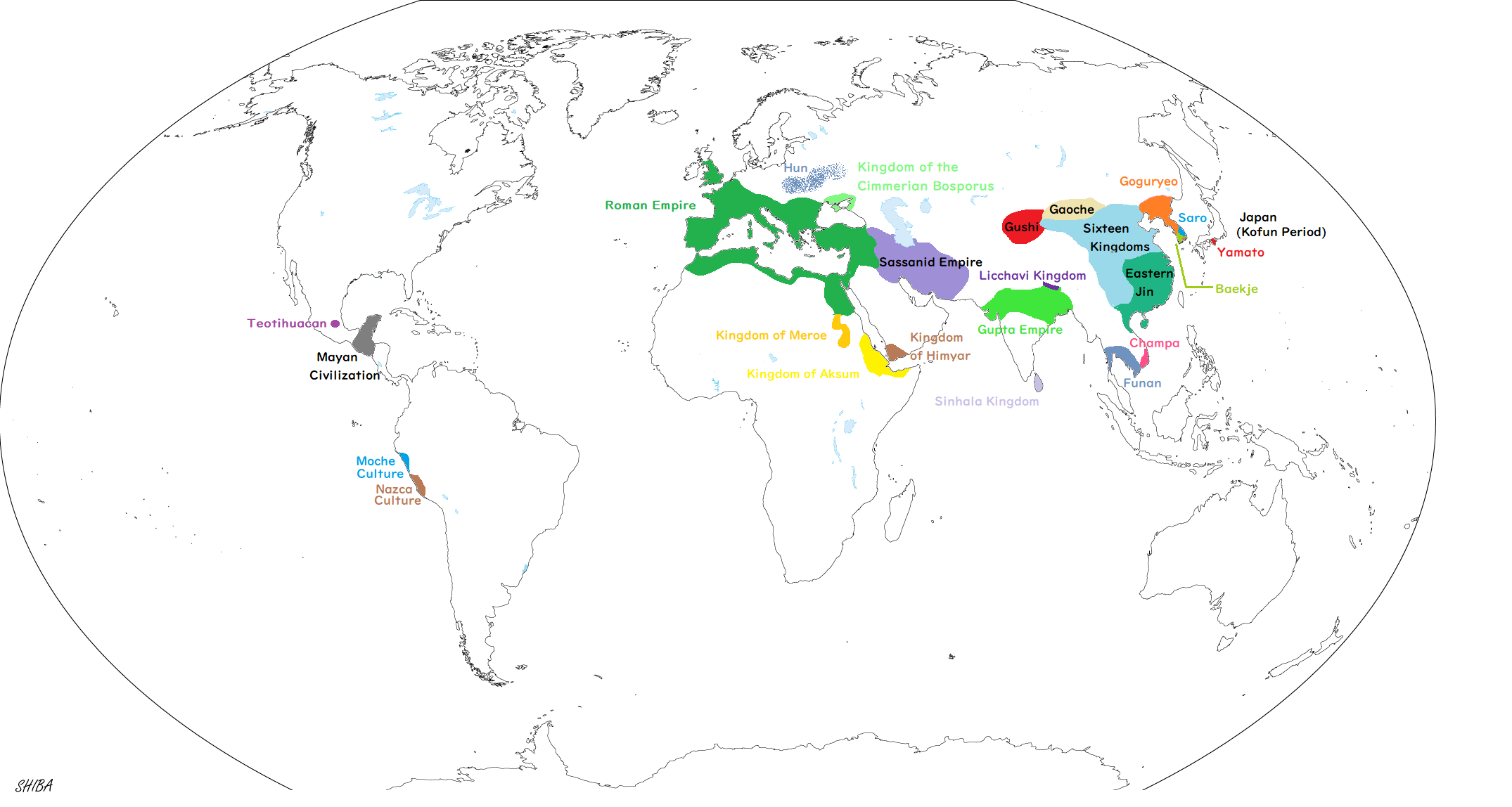
The era of “Barracks Emperors”, which brought chaos to the Roman Empire, finally subsided with the accession of Diocletian to the throne at the end of the 3rd century.
He attempted to curb the independence of regional powers and concentrate authority in the hands of the emperor by dividing the empire into four parts and appointing two senior emperors and two junior emperors in each (the Tetrarchy), thus establishing an absolute monarchy (the Dominate).
Diocletian is also known who persecuted Christians. However, even with his persecution, Christianity did not disappear. The number of believers of this religion was so increasing. Eventually, the monarchs came to recognize Christianity.
Caucasus,Africa
The first kingdom Christianized was Armenia, located in the Caucasus Mountains. At the time, this country was a disputed territory between the Sassanid Empire and the Roman Empire. In other words, it was a semi-independent country that was far from the center of both Empires and was not influenced by either.
In 301, King Tiridates III of Armenia was baptized and adopted Christianity as its official religion first in the world. After that, Armenia was conquered one after another by the great empires of Europe and West Asia, but Christianity (Armenian Church) supported the population each time, and continues to this day.
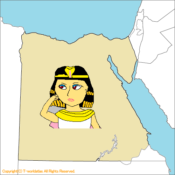
Christianity also spread to Africa. The Kingdom of Aksum, located in present-day Ethiopia, accepted Christianity during the reign of King Ezana in the mid-4th century, marking the beginning of the Ethiopian Church that continues to present day. Around his time, the Kingdom of Aksum became the largest power in East Africa, destroying the Kingdom of Meroe (present-day Sudan) and dominating the Kingdom of Himyar (present-day Yemen) on the opposite shore of the Red Sea.
After the collapse of the Kingdom of Meroe, new kingdoms such as Nobatia, Makuria, and Alodia arose in the Nubian region. These kingdoms likewise embraced Christianity.
Europe
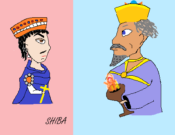
When Rome accepted Christianity was in 313 during the reign of Constantine the Great. He was a capable man who unified the empire, which was effectively divided into four, and it is said that he used Christianity to do so. He gained support by incorporating people who had previously been subject to persecution.
Once Christianity was accepted, the next problem arose, ”What is the orthodox Christianity?” This is because nearly 300 years have passed since the birth of Christianity, and various sects have sprung up. In order to clarify this issue, the Council of Nicaea was held in 325, and the thought of Athanasius who said “Jesus is the Son of God” was decided ”orthodox.”
On the other hand, there were naturally those who opposed the emperor’s policies, which went against tradition. Constantine constructed a new capital to Byzantium. The city was renamed “Constantinople”, that is now Istanbul. This is an important place for trade, as it is the junction between Asia and Europe, the Mediterranean Sea and the Black Sea.
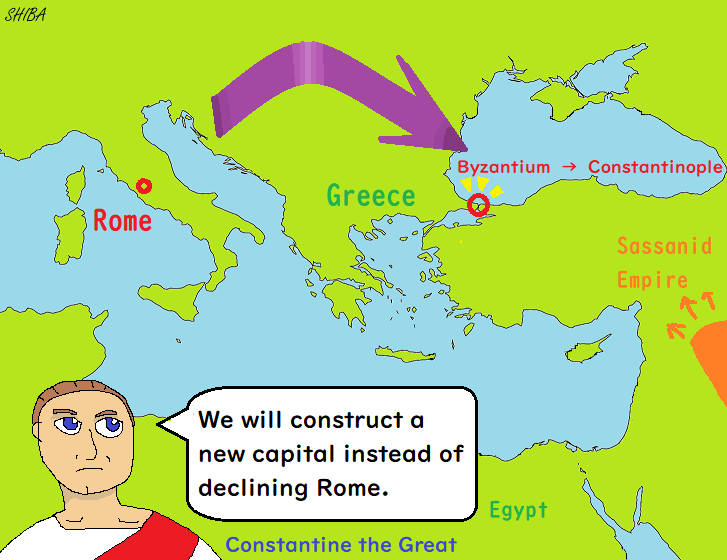
He gave up on the remaining conservatives in Rome and sought to rebuild the empire in Constantinople, where a variety of people, goods, and ideas came and went.
After Constantine, Rome repeatedly divided and unified, and nomadic tribes such as the Huns invaded. Christianity was once again suppressed by another emperor, but eventually gained citizenship.
Emperor Theodosius, who ascended the throne in 379, abandoned Rome’s traditional polytheism and finally made Christianity the state religion at the end of the 4th century. After this, major headquarters of Christianity were established in various parts of the empire, including Constantinople and Rome.
However, this kind of policy was a little too late to rebuild the Roman Empire. After the death of Emperor Theodosius in 395, the empire was once again divided. Rome was never reunited after this.
West Asia
The Sassanid Empire of Persia was under the reign of Shapur II for most of the 4th century. This man, who was a king from the moment he was born with a crown placed on his mother’s belly, persecuted Christians because the rival Roman Empire and the countries under its control, Armenia and Georgia accepted this religion. And he began to value their native religion, Zoroastrianism, more and more.
South Asia
In India, Gupta dynasty became a major power in its place. This dynasty, founded in the Ganges basin by Chandragupta I, took control of the coastal areas and flourished as a trading hub, just like previous Indian dynasties.
In terms of culture, a large amount of literature was written in Sanskrit, and excellent writers such as Kalidasa appeared. In the end of the 4th century, Chinese Buddhist monk Faxian (法显) set out for India.
China
At the end of the 3rd century, the civil war (the Eight Kings Rebellion: 八王之乱) broke out and destroyed Western Jin(西晋) dynasty’s unification. And it once again fell into a state of military division. During the civil war, nomadic tribes in the north of China were used as mercenaries, but they continued to remain in mainland China.
Thus, northern China entered a period of war, with short-lived nomadic dynasties repeatedly rising and falling. It is called the period of “Sixteen Kingdoms” and they were mainly built by Five Barbarians such as Xianbei(鮮卑)and Xiongnu(匈奴).
This confusing time was resolved after the establishment of the Northern Wei(北魏) Dynasty by the Tuoba(拓跋) people of Xianbei in 386.
On the other hand, in southern China, the survivors of the Western Jin Dynasty established the Eastern Jin Dynasty, and the period of the Northern and Southern Dynasties began here.
Chinese society was politically in flux, but culturally it was also undergoing major changes. That was the spread of Buddhism. This religion, which originated in India, came to China via the Silk Road during the Han Dynasty, and initially foreigners living in China practiced Buddhism.
However, in the 4th century, the number of believers also increased among the Chinese people. Fotu Cheng(佛图澄), a monk who built nearly 1000 temples in China, and Kumārajīva(鳩摩羅什), who translated many scriptures into Chinese. Both were from the city-state of Kucha(龜茲) on the Silk Road.
Korea / Japan
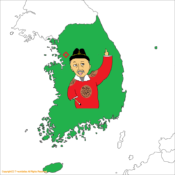
On the Korean peninsula, Baekje(百済) and Silla(新羅) stand out from the three Korean powers and grow larger. The three kingdoms, including Goguryeo(高句麗) in the north, began to compete with each other for power. Buddhism also spread to the Korean peninsula in the late 4th century.
Goguryeo was also in conflict with Lelang Commandery(乐浪郡), which was established by the Han Dynasty in China in the northern part of the Korean peninsula. In 313, King Micheon of Goguryeo finally destroyed it and wiped out Chinese power from the peninsula.
In Baekje, which became the largest kingdom in Mahan(馬韓), King Geunchogo who ascended the throne in 346 defeated Goguryeo in 371 and established the capital in Hansan. That is now Seoul. Silla was still called “Saro(斯盧)” at that time. And this kingdom became the largest country in the Jinhan(辰韓) region.
Goguryeo was defeated by Baekje, but in 391, when King Gwanggaeto ascended the throne, he conquered surrounding areas one after another, making Goguryeo’s area the largest in history. He also built stone monuments in the conquered areas.
There is little information about Japan, which was then called “Wa(倭)”, and there are many unknowns, but it is believed that the Yamato government was fully established around this time, and ancient tombs began to be built in various places. Trade with the Korean Peninsula, especially Baekje, also began during this period, and many immigrants called “toraijin(渡来人)” were thought to have passed on writing and techniques.
America
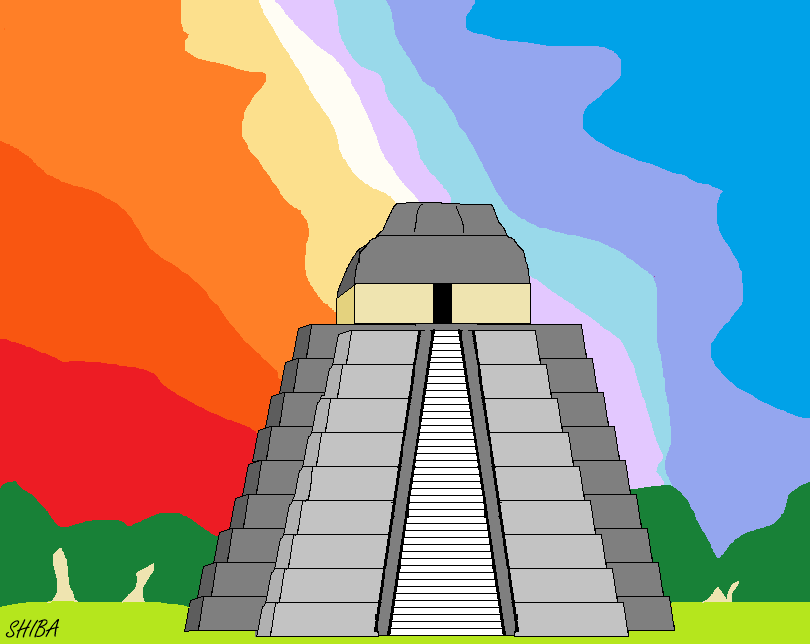
In Central America, it is thought that the Maya civilization flourished around this time, and large cities such as Copan and Tikal developed. Yax Nuun Ahiin I who ascended the throne of the Tikal (in present-day Guatemala) in the late 4th century, was from Teotihuacan, in what is now central Mexico. He introduced Teotihuacan architecture to Tikal and developed this city-state. It can be seen that a wide network had already been formed in Central America.
Event
301 Kingdom of Armenia, accepted Christianity (Caucasus)
309 Shahpur II ascended the throne
313 Edict of Milan Emperor Constantine recognizes Christianity (Roman Empire)
313 Goguryeo destroys Lelang Commandery (Korea)
316 Disaster of Yongjia: Fall of the Western Jin Dynasty (China)
Around 318~320 Chandragupta I established the Gupta dynasty (India)
325 Council of Nicea Athanasianism is decided as the orthodox Christian denomination
330 Capital of the Roman Empire moved to Constantinople (Roman Empire)
Around 350 Kingdom of Aksum destroyed the Kingdom of Meroe (East Africa)
372 Buddhism introduced to Goguryeo (Korea)
375 Invasion of the Huns; Migration Period began (Europe)
376 Chandragupta II ascended the throne (India)
379 Yax Nuun Ahiin I ascended the throne (Maya)
383 Battle of Fei River(淝水之战) Eastern Jin(東晋) defeated Former Qin(前秦)(China)
384 Buddhism introduced to Baekje (Korea)
386 Northern Wei(北魏) was established (China)
392 Emperor Theodosius made Christianity the state religion of Rome (Roman Empire)
395 Theodosius died; Rome is completely divided (Roman Empire)